Physics Nobel 2026 explained: how South Pole ice caught neutrinos from deep space
Francis Halzen won the 2026 Nobel Prize in Physics for IceCube, a cubic kilometre of Antarctic ice fitted with light sensors. Here is what it found and why it matters.
By John Christian Mmaduabuchi, Chief Editor
· 5 min read · Stockholm
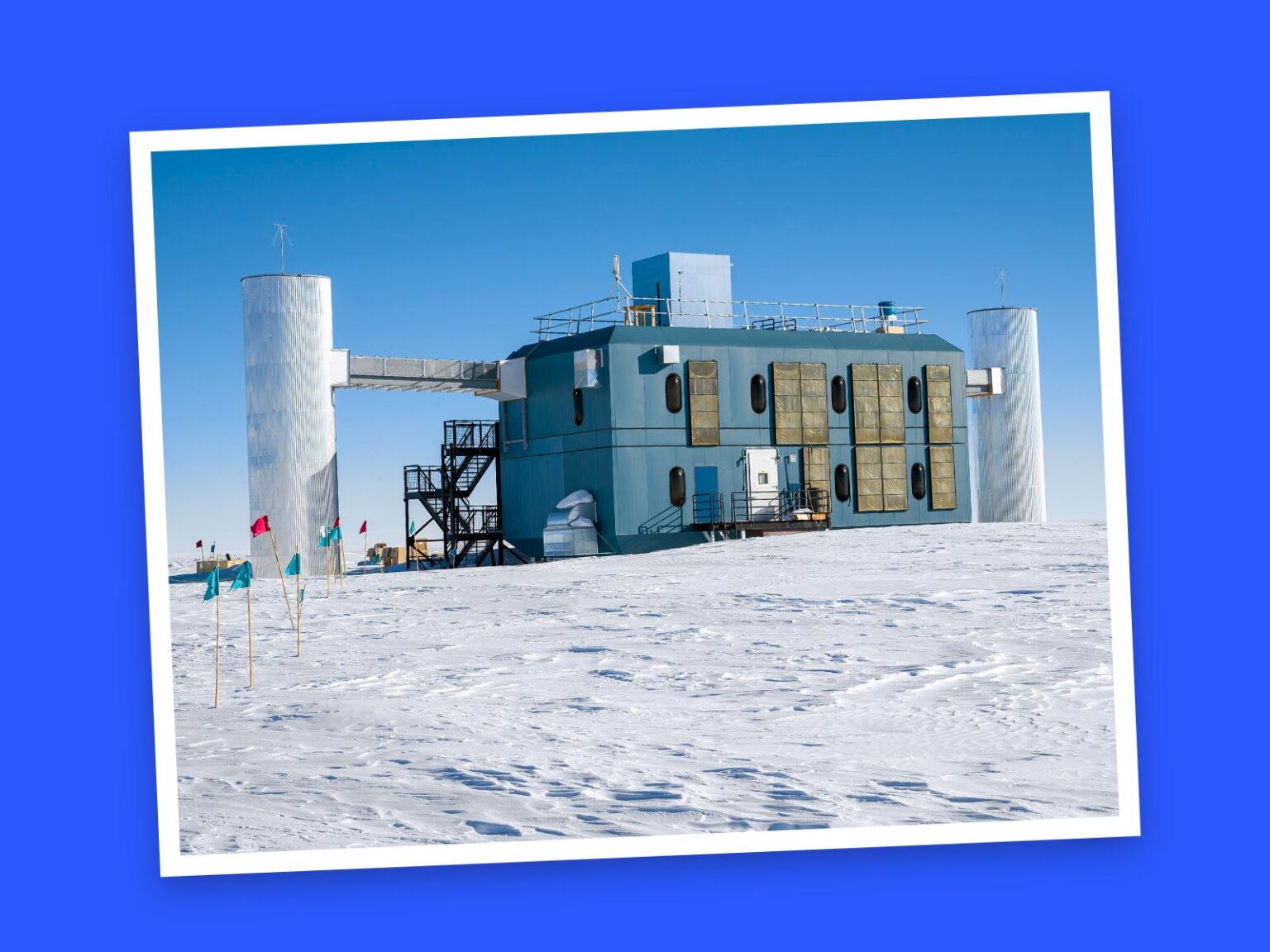
- Francis Halzen of the University of Wisconsin–Madison won the 2026 Nobel Prize in Physics, announced in Stockholm on Tuesday, 6 October 2026.
- The prize recognises his role in IceCube, a cubic kilometre of Antarctic ice fitted with 5,160 light sensors that catches neutrinos from deep space.
- IceCube reported the first evidence of cosmic neutrinos in 2013, and Halzen will receive the prize in Stockholm on Thursday, 10 December 2026.
The gist in 30 seconds
- Francis Halzen of the University of Wisconsin–Madison won the 2026 Nobel Prize in Physics, announced in Stockholm on Tuesday, 6 October 2026.
- The prize recognises his role in IceCube, a cubic kilometre of Antarctic ice fitted with 5,160 light sensors that catches neutrinos from deep space.
- IceCube reported the first evidence of cosmic neutrinos in 2013, and Halzen will receive the prize in Stockholm on Thursday, 10 December 2026.
Belgian-born physicist Francis Halzen has won the 2026 Nobel Prize in Physics for his work on the IceCube Neutrino Observatory, a giant detector buried in the ice at the South Pole. The Royal Swedish Academy of Sciences announced the award in Stockholm on Tuesday, 6 October 2026, citing his “decisive contributions to the IceCube Neutrino Observatory and the discovery of high-energy neutrinos of astrophysical origin”.
Halzen, 82, is a professor at the University of Wisconsin–Madison in the United States, according to the Academy’s press release. The prize is worth 12 million Swedish kronor, about $1.2 million, the Associated Press reported.
The prize rewards a new way of looking at the universe. Rather than relying only on light from distant objects, IceCube detects neutrinos, tiny particles that reach us without changing direction or losing energy, and so carry clues from some of the most violent places in the cosmos. “His tenacity and scientific vision has paved the way for a new kind of astronomy,” said Mark Pearce, Chair of the Nobel Committee for Physics.
What is a neutrino?
A neutrino has no electric charge and almost no mass, and it usually passes through matter without leaving a trace, the Academy explains. Every second, about 65 billion neutrinos from the Sun pass through your little fingernail without you noticing, according to its popular science background.
Very rarely, a neutrino hits an atomic nucleus. The collision produces a charged particle that gives off a blue light, and with the right equipment, scientists can trace that light back to the direction the neutrino came from.
How does IceCube catch them?
Halzen and his colleague John G. Learned first presented the idea of a neutrino observatory in South Pole ice at a conference in Poland in 1988, the Academy says. Deep Antarctic ice is dark, very clear and free of living creatures, and the area is geologically stable, with no earthquakes.
To build the detector, teams use hot water to melt holes deep into the ice, then lower long cables carrying light sensors into the water-filled holes. Halzen has described each sensor as a lightbulb in reverse: it captures light and turns it into an electrical signal, according to the Academy.
The first attempts to lower sensors into the ice came in 1992. A smaller predecessor, AMANDA, was built up to January 2000 but was not big enough to catch the highest-energy neutrinos. IceCube now fills a cubic kilometre of ice, with 5,160 sensors on 86 cables between 1,450 and 2,450 metres below the surface, and reached its full size in 2011, the Academy says.
What has IceCube found?
Most of what IceCube records comes from cosmic rays striking Earth’s atmosphere, so researchers must pick out the rare events that look different. In 2013 the team reported the first evidence of neutrinos from far beyond the solar system, and a couple of years later it had gathered enough data to be certain, according to the Academy.
IceCube has since pointed to possible sources. Seventy-nine of the neutrinos it has registered appear to come from the direction of NGC 1068, an active galaxy also known as M77, though the Academy says that evidence is not yet strong enough to confirm the galaxy as a source. The detector has also seen high-energy neutrinos coming from our own galaxy, the Milky Way.
Why does it matter?
The cosmos contains natural particle accelerators that fire out particles with energies up to a million times greater than laboratories on Earth can reach, the Academy says, and much about them is still a mystery. Those particles, mostly protons, carry an electric charge, so magnetic fields in space bend their paths and hide where they came from.
Neutrinos made in the same places are not affected by magnetic fields. They travel in straight lines, so they can point back to their source. That is why the Academy says IceCube’s data could even reveal cosmic phenomena that are not yet known.
It is also a reminder that modern physics is a team effort. The IceCube Collaboration includes more than 40 institutions around the world, according to the IceCube website.
Who is Francis Halzen?
Halzen was born in 1944 in Tienen, Belgium, and earned his PhD from KU Leuven in 1969, according to the Academy. He moved to the University of Wisconsin–Madison soon after his PhD. The university is IceCube’s lead institution, the AP reported.
He joined the announcement by phone from Italy. “It was a great surprise and I obviously didn’t expect it,” he said, according to the AP. To laughter from the audience, he added that he was working on a new proposal and hoped the prize would help get it approved.
What happens next
Halzen will receive the prize at the Nobel ceremony in Stockholm on Thursday, 10 December 2026. IceCube keeps collecting data, and a much larger successor, IceCube-Gen2, is being planned at the South Pole with eight cubic kilometres of ice, the Academy says.
The last of this year’s Nobel Prizes, in economic sciences, will be announced on Monday, 12 October. For more from this year’s prizes, read our explainer on the 2026 chemistry prize.
Sources
We checked this story against these sources. How we check
- NobelPrize.org: Press release: Nobel Prize in Physics 2026 (6 Oct 2026)
- NobelPrize.org: Popular information: Ice at the South Pole reveals cosmic particle accelerators (6 Oct 2026)
- Associated Press (via WUNC): Francis Halzen wins Nobel Prize in physics for work on high-energy neutrinos from space (6 Oct 2026)
- Associated Press (via Express & Star): Physics Nobel Prize awarded for research into cosmic neutrinos (6 Oct 2026)
- Reuters (via Daily Maverick): Francis Halzen wins 2026 Nobel Prize in Physics (6 Oct 2026)
- IceCube Neutrino Observatory: IceCube detector (accessed 10 Oct 2026)
How does this story make you feel?

John Christian Mmaduabuchi is a Nigerian filmmaker, creative director, and media professional with extensive experience in digital storytelling, visual journalism, and contemporary media. His Journalism interests span Nigerian and African current affairs, entertainment, culture, technology, lifestyle, media, and the people shaping public conversation. With a background in film direction and documentary production, he brings a strong visual and narrative perspective to editorial work, with particular attention to context, clarity, and compelling storytelling. John is also a creative entrepreneur focused on storytelling, entertainment, culture, and digital content. His professional experience across directing, cinematography, editing, media strategy, and emerging AI technologies gives him a broad understanding of how stories are created, distributed, and consumed in the digital age. At GistMatrix, John contributes to the development and presentation of timely, engaging, and relevant stories for a contemporary audience. His approach to editorial work is grounded in accuracy, context, responsible storytelling, and a commitment to covering stories that matter.




Join the conversation
Be sharp, be kind. Comments are checked before they appear. We remove insults, hate, spam and personal details. Community rules