Orionid meteor shower peaks this week: when to look from Lagos, Abuja and Kano
Pieces of Halley's Comet will streak across Nigeria's sky before dawn on Thursday, 22 October. A bright Moon gets in the way, so here is when it sets where you live.
By John Christian Mmaduabuchi, Chief Editor
· Video · Lagos, Abuja, Kano
The gist in 30 seconds
- The Orionid meteor shower peaks on the night of Wednesday, 21 October, into the morning of Thursday, 22 October 2026, according to NASA.
- A Moon about 80% lit will wash out fainter meteors, so the best time is after moonset and before dawn: about 03:14 to 05:22 in Lagos and 02:56 to 05:08 in Abuja, by GistMatrix's calculation.
- The shower is active until 7 November, and the night of 20 to 21 October offers a longer moon-free window before dawn.
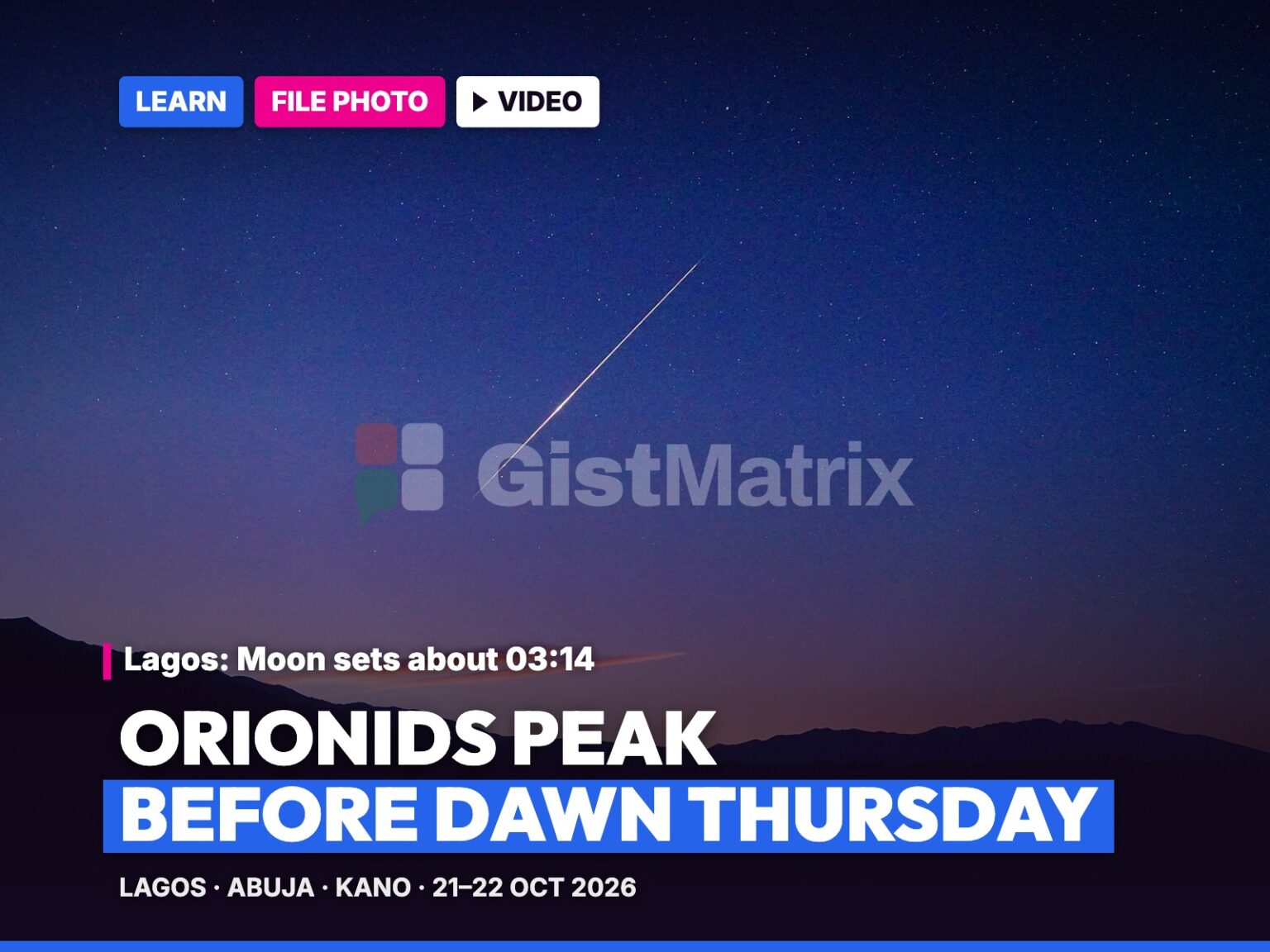
The Orionid meteor shower peaks on the night of Wednesday, 21 October, into the morning of Thursday, 22 October 2026, according to NASA, and anyone in Nigeria with a clear, dark sky can watch it with the naked eye. The best chance comes in the last hours before dawn, after the Moon has set.
The Orionids “are created by tiny pieces of debris left behind by Halley’s Comet”, NASA says in its October skywatching guide. They appear to come from the direction of the constellation Orion, which gives the shower its name, “but the meteors can streak across any part of the sky”.
Why does it matter?
It is a free show that needs no telescope, binoculars or app. The Royal Observatory Greenwich expects about 15 meteors an hour at the peak, and the American Meteor Society says a normal year brings 10 to 20 an hour at maximum. City lights and moonlight cut those numbers.
This year the Moon gets in the way. It will be about 80% lit on the peak night, the American Meteor Society says, and “a bright waxing gibbous Moon will wash out some of the fainter meteors this year”, according to NASA. That makes timing everything.
When should you look where you live?
NASA’s advice is to wait for the Moon to go down: “Your best chance may come in just a few hours before dawn, after the Moon sets.”
GistMatrix worked out when that happens in five Nigerian cities on the peak night, Wednesday 21 into Thursday 22 October, using the PyEphem astronomy software. All times are WAT:
- Lagos: the Moon sets at about 03:14. The sky starts to brighten at about 05:22, and the sun rises at about 06:32.
- Abuja: moonset about 02:56; the sky brightens about 05:08; sunrise about 06:18.
- Kano: moonset about 02:49; the sky brightens about 05:05; sunrise about 06:16.
- Port Harcourt: moonset about 03:00; the sky brightens about 05:06; sunrise about 06:16.
- Maiduguri: moonset about 02:30; the sky brightens about 04:46; sunrise about 05:57.
That leaves a dark window of a little over two hours before dawn. Times can differ by a few minutes across a city and depend on how low your horizon is.
Is the peak night the only chance?
No. The shower is active from 2 October to 7 November, and the Royal Observatory Greenwich says it has a broad maximum, so meteors can be seen for several nights either side of the peak.
Because the Moon sets about 45 minutes later each night, the nights before the peak are darker before dawn. On the night of Tuesday 20 into Wednesday 21 October, the Moon sets at about 02:28 in Lagos and 02:08 in Abuja, a GistMatrix calculation shows, leaving close to three hours of darker sky. By the night of Thursday 22 into Friday 23 October, it does not set in Lagos until about 04:01.
The radiant, the point in Orion that the meteors appear to come from, rises in the east at about 23:00 in Lagos and about 22:40 in Abuja, so few Orionids are seen in the evening. By 04:00 it is high in the sky over Nigeria, by GistMatrix’s calculation.
How do you watch?
- Find somewhere dark: get away from street lights and other light pollution, with a wide view of the whole sky, the Royal Observatory Greenwich advises. In Nigeria that also means security lights. A rooftop or an open compound works.
- Use your eyes: no telescope or binoculars are needed. Look at the whole sky rather than at Orion.
- Be patient: “Find a dark location. Give your eyes time to adjust and look up,” NASA says. Keep your phone screen off, because bright light undoes the adjustment.
- Get comfortable and stay safe: lie back on a mat or chair, and watch with someone else, close to home.
- Check the clouds: you need a clear sky, so look out of the window before you set an alarm.
How fast are they?
Orionids hit the atmosphere at about 66 kilometres a second, the American Meteor Society says, a speed it classes as swift. At that speed a meteor crosses the sky in a moment, so keep looking up rather than down at a screen.
What happens next
- The peak: before dawn on Thursday, 22 October, after moonset.
- A brighter Moon: the Moon becomes full early on Monday, 26 October, Nigerian time, so the nights after the peak get brighter.
- The end: the shower fades out by 7 November.
The video with this story is NASA’s October skywatching guide, from its Jet Propulsion Laboratory.
Did you catch an Orionid? Send GistMatrix your photo or video, tell us where you took it, and we may feature it, with credit to you.
Sources
We checked this story against these sources. How we check
- NASA Jet Propulsion Laboratory: What's Up: October 2026 Skywatching Tips from NASA (1 Oct 2026)
- American Meteor Society: Meteor Shower Calendar 2026-2027 (2026)
- Royal Museums Greenwich: Orionid meteor shower 2026: when and where to see it (2026)
- NASA JPL (YouTube): What's Up: October 2026 Skywatching Tips from NASA (1 Oct 2026)
- GistMatrix: moonset, radiant rise and dawn times for five Nigerian cities, calculated with PyEphem (20 Oct 2026)
Have your say
Will you stay up for the Orionids this week?
One tap to vote. You will see how everyone else voted.
How does this story make you feel?

John Christian Mmaduabuchi is a Nigerian filmmaker, creative director, and media professional with extensive experience in digital storytelling, visual journalism, and contemporary media. His Journalism interests span Nigerian and African current affairs, entertainment, culture, technology, lifestyle, media, and the people shaping public conversation. With a background in film direction and documentary production, he brings a strong visual and narrative perspective to editorial work, with particular attention to context, clarity, and compelling storytelling. John is also a creative entrepreneur focused on storytelling, entertainment, culture, and digital content. His professional experience across directing, cinematography, editing, media strategy, and emerging AI technologies gives him a broad understanding of how stories are created, distributed, and consumed in the digital age. At GistMatrix, John contributes to the development and presentation of timely, engaging, and relevant stories for a contemporary audience. His approach to editorial work is grounded in accuracy, context, responsible storytelling, and a commitment to covering stories that matter.




Join the conversation
Be sharp, be kind. Comments are checked before they appear. We remove insults, hate, spam and personal details. Community rules