FG disputes World Bank’s 124% interest-to-revenue figure: what the numbers mean
The finance ministry calls a 124% interest-to-revenue figure from the World Bank's report misleading. Here is what ₦7.7trn in interest against ₦6.2trn in revenue measures, and why it matters.
By John Christian Mmaduabuchi, Chief Editor
· Video · Abuja
The gist in 30 seconds
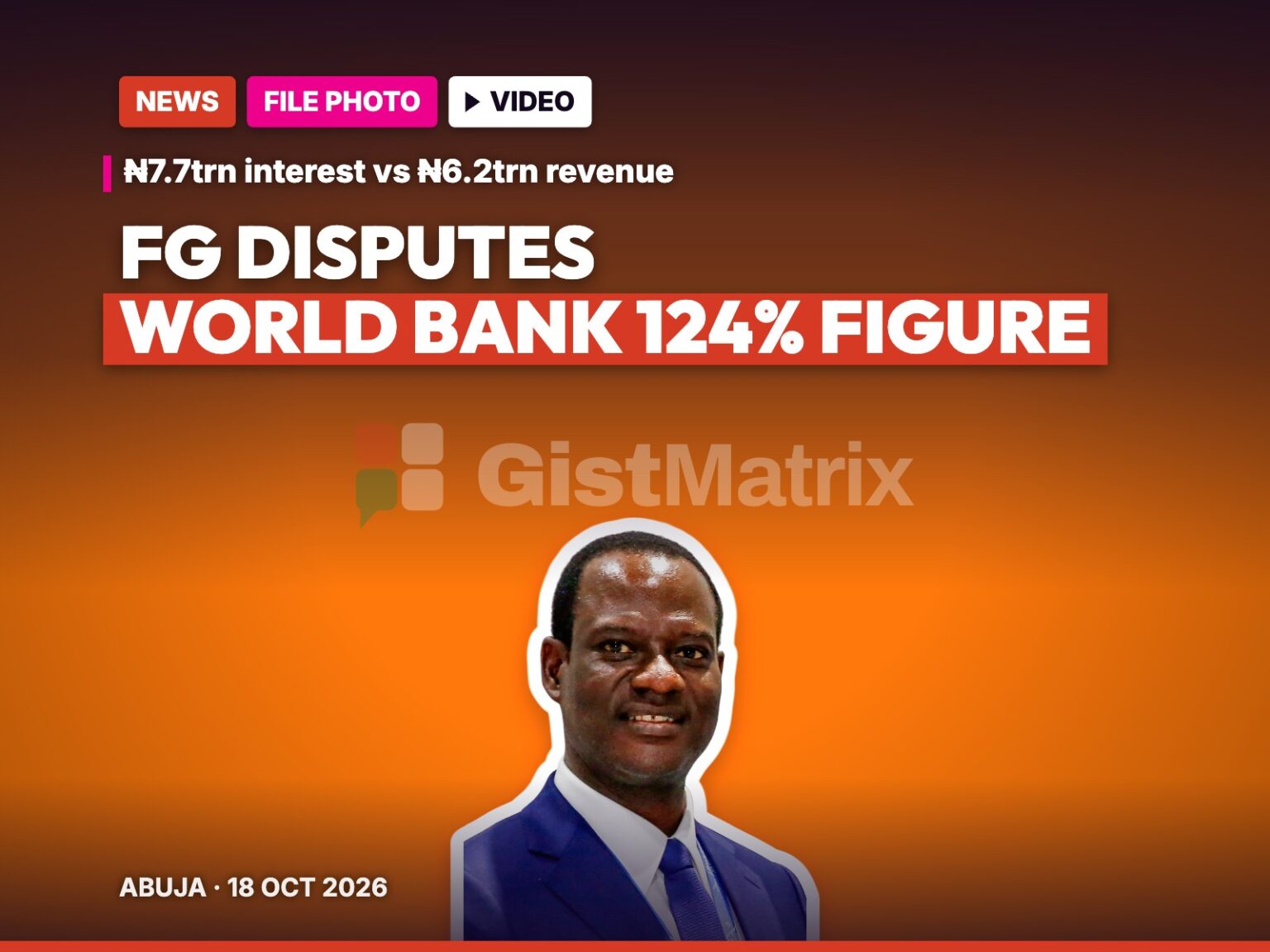
- The Federal Ministry of Finance said on Sunday, 18 October 2026, that a 124% interest-to-revenue figure drawn from the World Bank's October 2026 Nigeria Development Update is misleading.
- The figure sets ₦7.7 trillion in federal interest payments in the first half of 2026 against ₦6.2 trillion in federal revenue; the ministry says revenue grew 72% while interest grew 38%.
- The ministry says the right test is the full year, pointing to the World Bank's projection that debt service will equal 46% of revenue in 2026.
The Federal Ministry of Finance has rejected a 124% interest-to-revenue figure drawn from the World Bank’s latest report on Nigeria, calling the conclusion misleading in a statement issued in Abuja on Sunday, 18 October 2026. The Minister of Finance and Coordinating Minister of the Economy, Taiwo Oyedele, shared the statement on X.
The figure sets the ₦7.7 trillion the Federal Government paid in interest in the first half of 2026 against the ₦6.2 trillion it earned in revenue over the same six months, figures from the World Bank’s October 2026 Nigeria Development Update that the ministry repeated in its statement. The ministry does not dispute the two numbers. It disputes what they are being used to show.
Why does it matter to you?
Interest is the cost of money the government has already borrowed, and it has to be paid. Every naira that goes on interest is a naira that cannot be spent on roads, hospitals or schools, so the size of the bill shapes what the government can do for everyone else.
Nigeria’s public debt stood at ₦166.79 trillion at the end of June 2026, according to Debt Management Office (DMO) figures reported by Nairametrics. The Federal Government owed about ₦152.77 trillion of it, and the 36 states and the Federal Capital Territory about ₦14.01 trillion.
What did the finance ministry say?
“This conclusion is misleading, for three reasons,” the ministry said, Channels Television reported. It gave these:
- Debts it pays for others: “The interest figure includes debt the Federal Government services on behalf of other tiers of government,” including external loans taken for states. “Measuring this against federal revenue alone overstates the ratio,” the ministry said.
- Money not yet counted: the revenue figure “excludes independent revenue already earned by government agencies and enterprises” that had not yet been paid into the Treasury.
- Half a year is not a year: some taxes are collected mostly in the second half of the year. “Debt sustainability is assessed on a full-year basis, not over six months,” the ministry said.
It said federal revenue rose 72%, from ₦3.6 trillion in the first half of 2025 to ₦6.2 trillion, while interest payments rose 38%, from ₦5.6 trillion to ₦7.7 trillion. “Revenue is therefore growing almost twice as fast as interest costs,” it said. “This is the result of reforms working, not a sign of fiscal distress.”
Why are there two such different numbers?
Because they measure different things. Some reports of the statement said the ratio is 60%, not 124%. That is not what the ministry said.
- Interest-to-revenue, 124%: interest only, for the first six months of 2026, set against federal revenue for the same six months. The ministry said the same ratio was 156% in the first half of 2025.
- Debt service-to-revenue, below 60% in 2025: interest plus repayments of the loans themselves, over a full year. The ministry said this ratio fell below 60% in 2025, from 97% before the government’s reforms.
- The World Bank’s forecast, 46%: the ministry pointed to the report’s projection that debt service, interest and repayments together, will equal 46% of revenue for the whole of 2026, and called it “the appropriate benchmark”.
The first is a six-month, interest-only measure; the other two cover a full year and include repayments. They cannot be compared directly.
What do the figures show? A GistMatrix calculation
Using only the figures in the ministry’s statement:
- For every ₦100 the Federal Government earned in the first half of 2026, it paid about ₦124 in interest. A year earlier, it paid about ₦156.
- Revenue grew by about ₦2.6 trillion over the year, while the interest bill grew by about ₦2.1 trillion.
- Interest still exceeded revenue by about ₦1.5 trillion in the first half of 2026, down from about ₦2 trillion a year earlier.
Both readings come from the same numbers: the gap is narrowing, as the ministry says, and over those six months interest still cost more than federal revenue brought in, as the 124% figure shows.
Is the borrowing within the law?
The ministry said all federal borrowing is within the limits approved by the National Assembly under the 2026 Appropriation Act and the approved borrowing plan, and complies with the Fiscal Responsibility Act 2007 and the Debt Management Office (Establishment) Act 2003. “Every naira borrowed by the Federal Government falls within the limits approved by the National Assembly,” it said.
It asked analysts to “compare like with like, read figures in context, and seek clarification where the data is unclear”, Arise News reported.
The World Bank released the report, titled Beyond the Federal Purse, in Abuja on Thursday, 8 October 2026. It said real GDP grew 4.2% in the first half of 2026, up from 3.9% a year earlier. President Bola Tinubu welcomed the report three days later. “The dividends of reform are becoming visible,” his office said in a State House statement.
No response from the World Bank to the ministry’s statement was reported by Channels Television, Arise News or the other outlets that carried it on 18 and 19 October.
What happens next
- The full year: the ministry says the full year is the right test. Watch whether the second half of 2026 brings in the tax receipts it expects, and what the full-year accounts show.
- The DMO’s next figures: the debt figures for the end of September 2026 will show whether the debt stock kept rising after June.
- The World Bank: watch for any reply to the ministry’s three objections.
The video with this story is TVC News’s report on the ministry’s statement.
Do you work with government budgets, or run a business that feels the cost of high interest rates? Tell GistMatrix what these numbers mean on the ground.
Sources
We checked this story against these sources. How we check
- Federal Ministry of Finance: statement on the World Bank's interest-to-revenue figure, as published by Arise News (18 Oct 2026)
- Channels Television: Nigeria Disagrees With World Bank Over ₦7.7tn Debt Interest Payments (19 Oct 2026)
- World Bank: Nigeria Development Update, Beyond the Federal Purse (8 Oct 2026)
- World Bank: From Higher Revenues to Better Lives, press release (8 Oct 2026)
- State House: President Tinubu welcomes World Bank's latest report (11 Oct 2026)
- Nairametrics (DMO data): Nigeria's public debt rises to N166.79 trillion in Q2 2026 (26 Sep 2026)
- TVC News (YouTube): FG Disagrees With World Bank Over H1 124% Debt Servicing/Revenue Ratio (19 Oct 2026)
- GistMatrix: calculation of interest paid per ₦100 of federal revenue from the ministry's figures (20 Oct 2026)
How does this story make you feel?

John Christian Mmaduabuchi is a Nigerian filmmaker, creative director, and media professional with extensive experience in digital storytelling, visual journalism, and contemporary media. His Journalism interests span Nigerian and African current affairs, entertainment, culture, technology, lifestyle, media, and the people shaping public conversation. With a background in film direction and documentary production, he brings a strong visual and narrative perspective to editorial work, with particular attention to context, clarity, and compelling storytelling. John is also a creative entrepreneur focused on storytelling, entertainment, culture, and digital content. His professional experience across directing, cinematography, editing, media strategy, and emerging AI technologies gives him a broad understanding of how stories are created, distributed, and consumed in the digital age. At GistMatrix, John contributes to the development and presentation of timely, engaging, and relevant stories for a contemporary audience. His approach to editorial work is grounded in accuracy, context, responsible storytelling, and a commitment to covering stories that matter.



Join the conversation
Be sharp, be kind. Comments are checked before they appear. We remove insults, hate, spam and personal details. Community rules