First Niger Bridge reopens after 38 days: what has changed for motorists
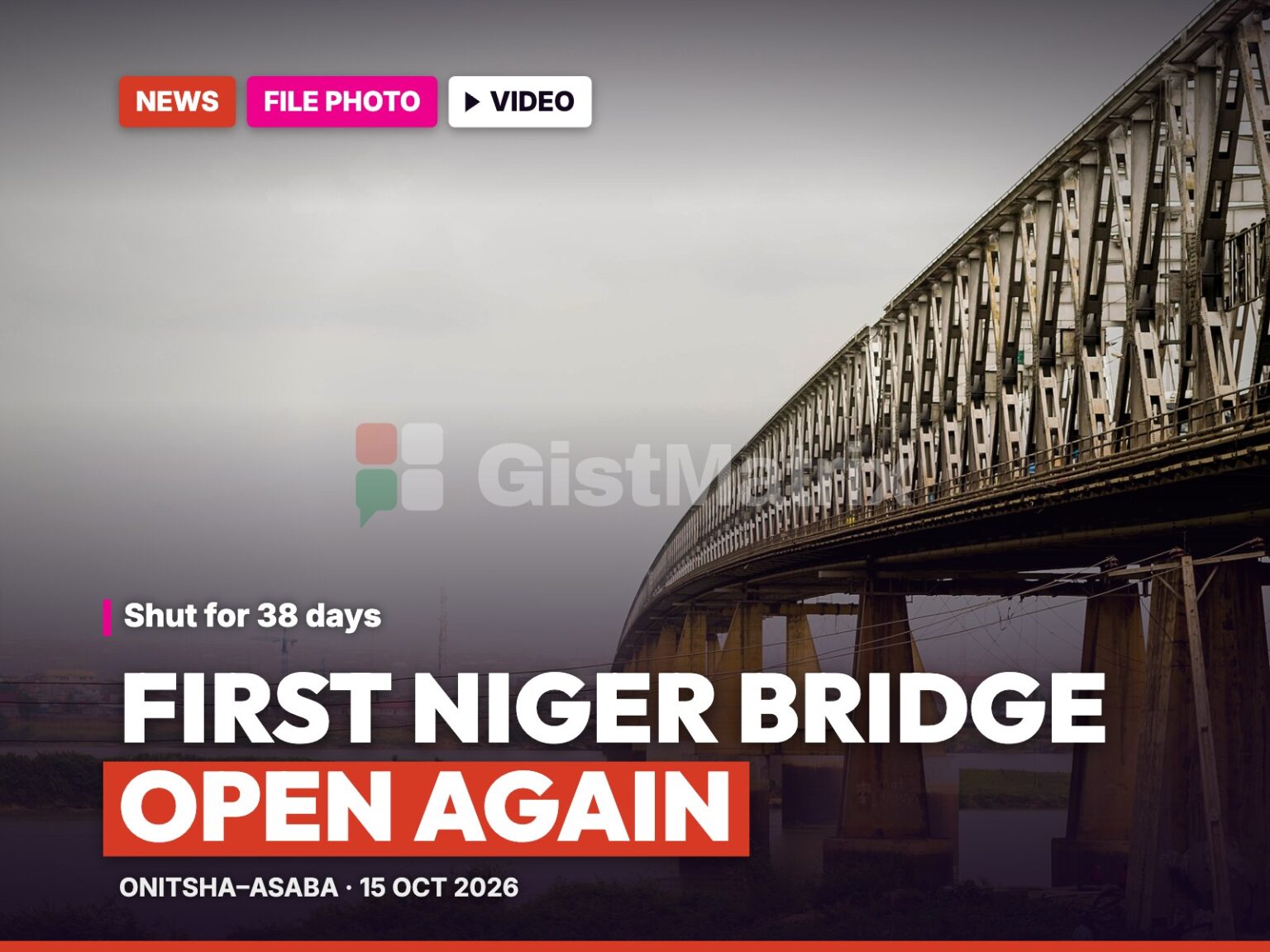
The Onitsha-Asaba bridge is open again after repairs that ran 24 days past schedule, with new CCTV, solar lights, emergency turnarounds and a dredging ban nearby.
By John Christian Mmaduabuchi, Chief Editor
· Video · Onitsha
The gist in 30 seconds
- Works Minister David Umahi reopened the First Niger Bridge between Onitsha and Asaba on Thursday, 15 October 2026, after 38 days of closure.
- The bridge was shut on 7 September 2026 for what was meant to be two weeks of repairs, and the ministry blamed persistent rainfall for the delay.
- Umahi directed officials in Anambra and Delta states to enforce the ban on sand dredging within 10 kilometres of federal bridges.
The First Niger Bridge between Onitsha in Anambra State and Asaba in Delta State is open to traffic again. The Minister of Works, David Umahi, declared it open on Thursday, 15 October 2026, after 38 days of emergency repairs.
The Federal Ministry of Works shut the bridge on Monday, 7 September for what it said would be two weeks of work, due to end on 21 September. A GistMatrix count of the ministry’s own dates shows the repairs ran 24 days past that deadline, close to three times as long as planned.
Why it matters
The bridge, completed in 1965, carries traffic between the South-East and the rest of the country through Onitsha and Asaba. While it was shut, the ministry directed motorists to the Second Niger Bridge, reached through Obosi, leaving road users between the two cities with a single crossing.
What has changed on the bridge?
According to the ministry and Umahi, the work included:
- repairs to the steel structure, after vandals removed bolts and parts of the expansion-joint steelwork;
- a new road surface: the ministry’s closure notice said the worn asphalt would be milled off and replaced with about 40mm of new asphalt;
- solar-powered streetlights and CCTV cameras;
- median barriers, with three turnaround points for emergencies and breakdowns;
- security observation centres, still being set up at both ends to watch activity on and beneath the bridge.
Earlier this month, posts on social media claimed the new barriers were being pulled down after complaints. The Federal Controller of Works in Anambra State, Timothy Emenike, denied it, saying the gaps were left for the Federal Road Safety Corps, fire service and other emergency vehicles. “What we simply did was create U-turns for vehicles for emergency purposes,” he said.
Why did it take 38 days?
The ministry blamed the weather. Emenike said the reopening was delayed because “persistent rainfall hampered the ongoing maintenance works on the ageing bridge.”
The ministry’s closure notice, signed by Emenike, said the bridge’s surface had deteriorated and that the damage included the “expansion joint steelworks and stanchion/steel truss nuts and bolts”.
What Umahi ordered
Umahi said federal rules ban sand dredging within 10 kilometres of federal bridges, and directed federal officials in Delta and Anambra states to enforce the ban immediately, warning that officials who fail to act would face disciplinary action. He also said the bridge must be protected from overloading and congestion.
Delta State Governor Sheriff Oborevwori, represented by his Commissioner for Works (Rural Roads) and Public Information, Charles Aniagwu, warned of the cost of neglect: “If this bridge is allowed to collapse, it will not just affect the movement of people between the South and the East,” he said, adding that the economies of both regions would suffer.
The Asagba of Asaba, Professor Epiphany Azinge, SAN, said: “This may be the second most comprehensive intervention made so far on this bridge since its construction”.
Politics at the reopening
Umahi used the ceremony to praise President Bola Tinubu, saying he was opening the bridge “in our deep appreciation of what he has done for the people of South-South and South-east”, and asked residents of both regions to back the President’s re-election bid in 2027.
Umahi had earlier ordered illegal adverts on the bridge to be removed and replaced with pictures of the President. Parrot Nigeria reported that pictures of Tinubu, Vice-President Kashim Shettima and Anambra Governor Chukwuma Soludo, as well as APC banners, were on the bridge at the reopening.
What happens next
The security observation centres at both ends of the bridge are still being built. Umahi also said President Tinubu had directed a full redesign of the Benin-Asaba Expressway, after the government cancelled the remedial contract for its first 11 kilometres over the quality of work, and that about 400 kilometres of the East-West Road would be rebuilt as a spur of the 750-kilometre Lagos-Calabar Coastal Highway.
Work also continues on the 17.5-kilometre Second Niger Bridge bypass, valued at about ₦172 billion.
Have you crossed the bridge since Thursday? Send GistMatrix your videos and tips.
Sources
We checked this story against these sources. How we check
- Federal Ministry of Works: Two-week closure notice for the First Niger Bridge, signed by Timothy Emenike, as carried by ThisDay (4 Sep 2026)
- Channels Television: FG Reopens First Niger Bridge (15 Oct 2026)
- The Guardian Nigeria: FG Reopens First Niger Bridge, Installs CCTV, Solar Streetlights (15 Oct 2026)
- News Agency of Nigeria, via Peoples Gazette: FG reopens First Niger Bridge after 38 days (15 Oct 2026)
- Tribune Online: FG reopens First Niger Bridge after 38 days of closure (16 Oct 2026)
- Premium Times: Nigerian govt reopens First Niger Bridge after 38 days of closure (16 Oct 2026)
- Vanguard: Works Ministry debunks First Niger Bridge demarcation removal claims (7 Oct 2026)
- Parrot Nigeria: Umahi reopens First Niger Bridge adorned with Tinubu's pictures (16 Oct 2026)
- TVC News: Federal Govt Reopens Rehabilitated First Niger Bridge In Onitsha (16 Oct 2026)
How does this story make you feel?

John Christian Mmaduabuchi is a Nigerian filmmaker, creative director, and media professional with extensive experience in digital storytelling, visual journalism, and contemporary media. His Journalism interests span Nigerian and African current affairs, entertainment, culture, technology, lifestyle, media, and the people shaping public conversation. With a background in film direction and documentary production, he brings a strong visual and narrative perspective to editorial work, with particular attention to context, clarity, and compelling storytelling. John is also a creative entrepreneur focused on storytelling, entertainment, culture, and digital content. His professional experience across directing, cinematography, editing, media strategy, and emerging AI technologies gives him a broad understanding of how stories are created, distributed, and consumed in the digital age. At GistMatrix, John contributes to the development and presentation of timely, engaging, and relevant stories for a contemporary audience. His approach to editorial work is grounded in accuracy, context, responsible storytelling, and a commitment to covering stories that matter.
Join the conversation
Be sharp, be kind. Comments are checked before they appear. We remove insults, hate, spam and personal details. Community rules