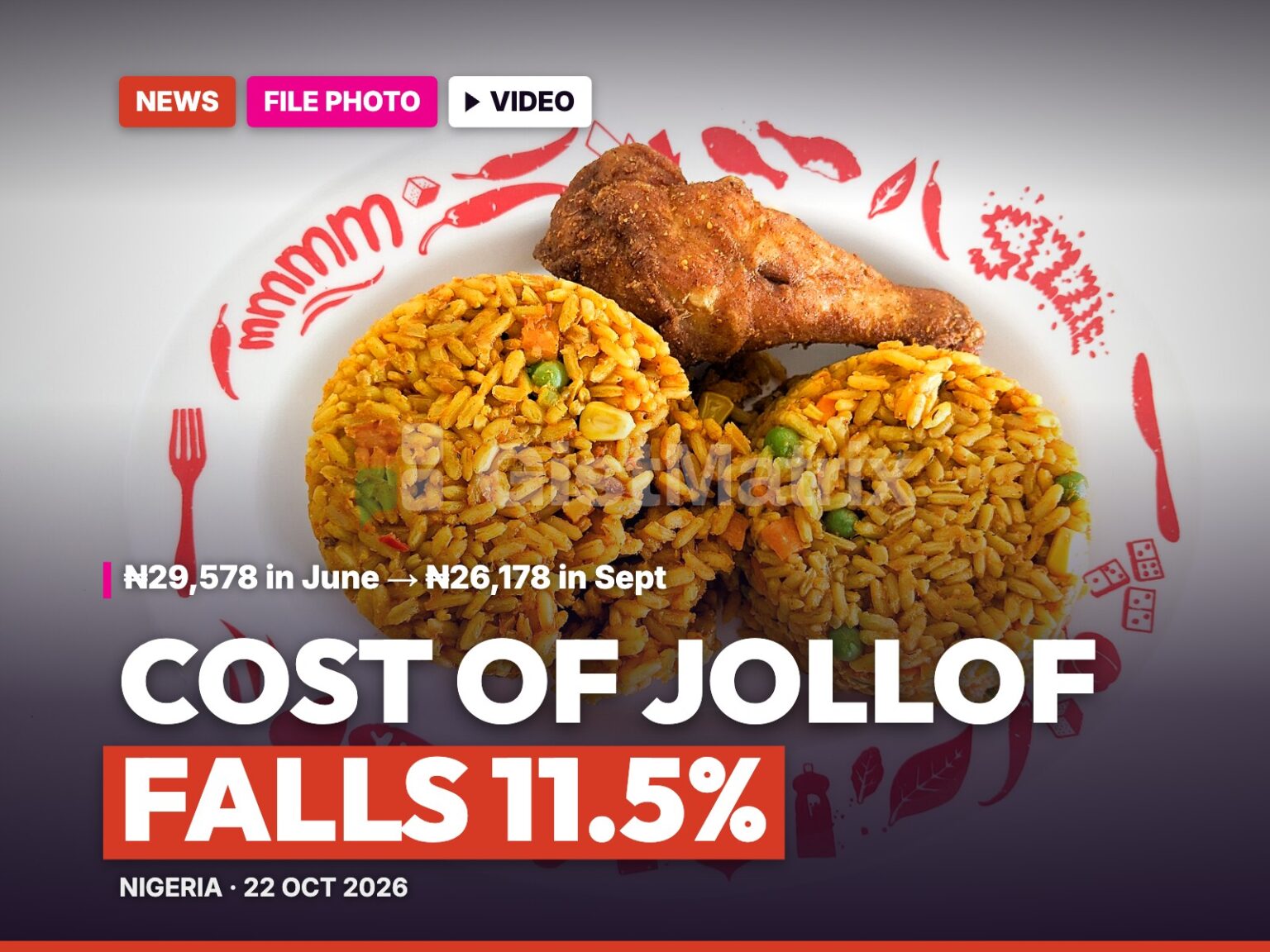
Cost of a pot of jollof falls 11.5% to ₦26,178 as chicken and oil get cheaper
SBM Intelligence’s Jollof Index has recorded its sharpest quarterly fall in ten years. But the pot still costs more than a year ago, and Port Harcourt went the other way.
By John Christian Mmaduabuchi, Chief Editor
· Video · Nigeria
The gist in 30 seconds
- The cost of a pot of jollof fell 11.5% from ₦29,578 in June to ₦26,178 in September 2026, SBM Intelligence’s Jollof Index shows.
- Cheaper chicken and vegetable oil drove the fall, while rice barely changed and Port Harcourt was the only one of 13 markets to get dearer.
- SBM said that without a recording error in Ibadan the fall would have been 8.5%, and the pot is still 5.8% dearer than in September 2025.
The cost of cooking a pot of jollof rice in Nigeria fell by 11.5% between June and September 2026, from ₦29,578 to ₦26,178, according to the latest Jollof Index from the research firm SBM Intelligence, published this week. The firm called it “the sharpest quarterly decline in the SBM Jollof Index’s ten-year history”.
Cheaper chicken and vegetable oil did most of the work, while rice barely moved. The fall was also uneven: the pot got more than a third cheaper in Lagos, but Port Harcourt was the one market where it cost more.
Why it matters
SBM has priced the same pot of jollof since July 2016 as a simple guide to what food costs ordinary households. It prices a fixed list of ingredients, including rice, chicken, beef, tomatoes, pepper, onions and vegetable oil, in 13 markets across Nigeria’s six geopolitical zones.
The fall fits the wider picture. The National Bureau of Statistics said headline inflation fell to 14.63% in September, with food prices dropping month on month. Even so, by GistMatrix’s calculation, one pot at September’s national average costs about 37% of the ₦70,000 monthly national minimum wage, down from about 42% in June.
What got cheaper?
Across the 13 markets combined, chicken fell by ₦9,700 and vegetable oil by ₦7,350 between June and September, SBM said. In Lagos, the report showed a 90cl bottle of vegetable oil dropping from ₦5,000 to ₦3,000.
Rice, the base of the dish, hardly changed. “Rice, the ingredient that gives the dish its name, moved by just ₦50 across the entire basket,” the report said.
Not everything got cheaper. SBM said beef rose in Kano because of the cost of moving cattle from Yobe, Borno and Niger Republic, and because insecurity limits where herders can move. Its explanation for why chicken fell faster than beef was short: “Poultry recovers in six weeks. Cattle take years.”
Where is jollof cheapest and dearest?
- Dearest: Calabar Municipal at ₦34,600 and Bayside Mbakpa at ₦34,500 in September, making the South-South the most expensive region.
- Cheapest: Awka and Onitsha, at ₦21,350 each.
- Biggest fall: Lagos (Trade Fair and Balogun markets), down 35.6% from ₦34,700 in June to ₦22,350.
- Only rise: Port Harcourt, up 2.6% from ₦31,200 to ₦32,000, which SBM linked to flooding in the city.
A GistMatrix comparison of those figures shows that the same pot cost ₦13,250 more in Calabar Municipal than in Awka or Onitsha in September, about 62% more. SBM also noted that nine of the 13 markets fell by less than 10%, so the national figure hides a lot of variation.
Is the fall as big as it looks?
Not quite. SBM said part of the drop came from a recording error in the two Ibadan markets, Bodija and Dugbe, where curry and thyme had been logged at about ₦3,500 each before falling to around ₦650. That was a mistake in the units, not a real price change. Without it, the firm said, the national fall would be 8.5%, with an average of roughly ₦27,055.
The pot is also still dearer than a year ago. “The pot is cheaper than it was in June, still 5.8% dearer than it was last September, and 540% above its July 2016 level,” the report said.
SBM Intelligence analyst Veronica Igube discussed the findings on the Lagos radio station Smooth 98.1 FM on Wednesday. The full interview is in the video on this page.
What it means for you
- Protein and oil: in most markets, chicken and vegetable oil should cost noticeably less than they did in June.
- Rice: do not expect much change. It was almost flat across the basket.
- Where you shop matters: the gap between the cheapest and dearest markets is far bigger than the national fall.
What happens next
- November 2026: the NBS is due to publish October’s inflation figures, which will show whether food prices kept easing.
- December: demand for rice, chicken and oil usually rises in the festive season. Watch whether the lower prices hold.
- The next Jollof Index: SBM publishes the index every quarter. The next edition will cover October to December.
What does a pot of jollof cost you now? Tell GistMatrix what you are paying in your market, with a photo of the price if you can, and we may include it in our next update.
Sources
We checked this story against these sources. How we check
- SBM Intelligence: The SBM Jollof Index, Q3 2026: The Pot Cools, but Not Everywhere (22 Oct 2026)
- Smooth 98.1 FM (YouTube): #PersonalFinance981: The Cost Of A Pot Of Jollof Fell 11.5% In Q3 2026 (22 Oct 2026)
- GistMatrix: analysis of SBM Jollof Index market figures and the ₦70,000 minimum wage (22 Oct 2026)
- Premium Times: Cheaper chicken, vegetable oil drive 11.5% fall in jollof rice cost – Report (21 Oct 2026)
- BusinessDay: Cost of cooking jollof records sharpest quarterly decline in a decade to N26,178 (21 Oct 2026)
- GistMatrix: Inflation falls to 14.63% in September as food prices drop month on month (16 Oct 2026)
Have your say
Have food prices in your market come down since June?
One tap to vote. You will see how everyone else voted.
How does this story make you feel?

John Christian Mmaduabuchi is a Nigerian filmmaker, creative director, and media professional with extensive experience in digital storytelling, visual journalism, and contemporary media. His Journalism interests span Nigerian and African current affairs, entertainment, culture, technology, lifestyle, media, and the people shaping public conversation. With a background in film direction and documentary production, he brings a strong visual and narrative perspective to editorial work, with particular attention to context, clarity, and compelling storytelling. John is also a creative entrepreneur focused on storytelling, entertainment, culture, and digital content. His professional experience across directing, cinematography, editing, media strategy, and emerging AI technologies gives him a broad understanding of how stories are created, distributed, and consumed in the digital age. At GistMatrix, John contributes to the development and presentation of timely, engaging, and relevant stories for a contemporary audience. His approach to editorial work is grounded in accuracy, context, responsible storytelling, and a commitment to covering stories that matter.



Join the conversation
Be sharp, be kind. Comments are checked before they appear. We remove insults, hate, spam and personal details. Community rules