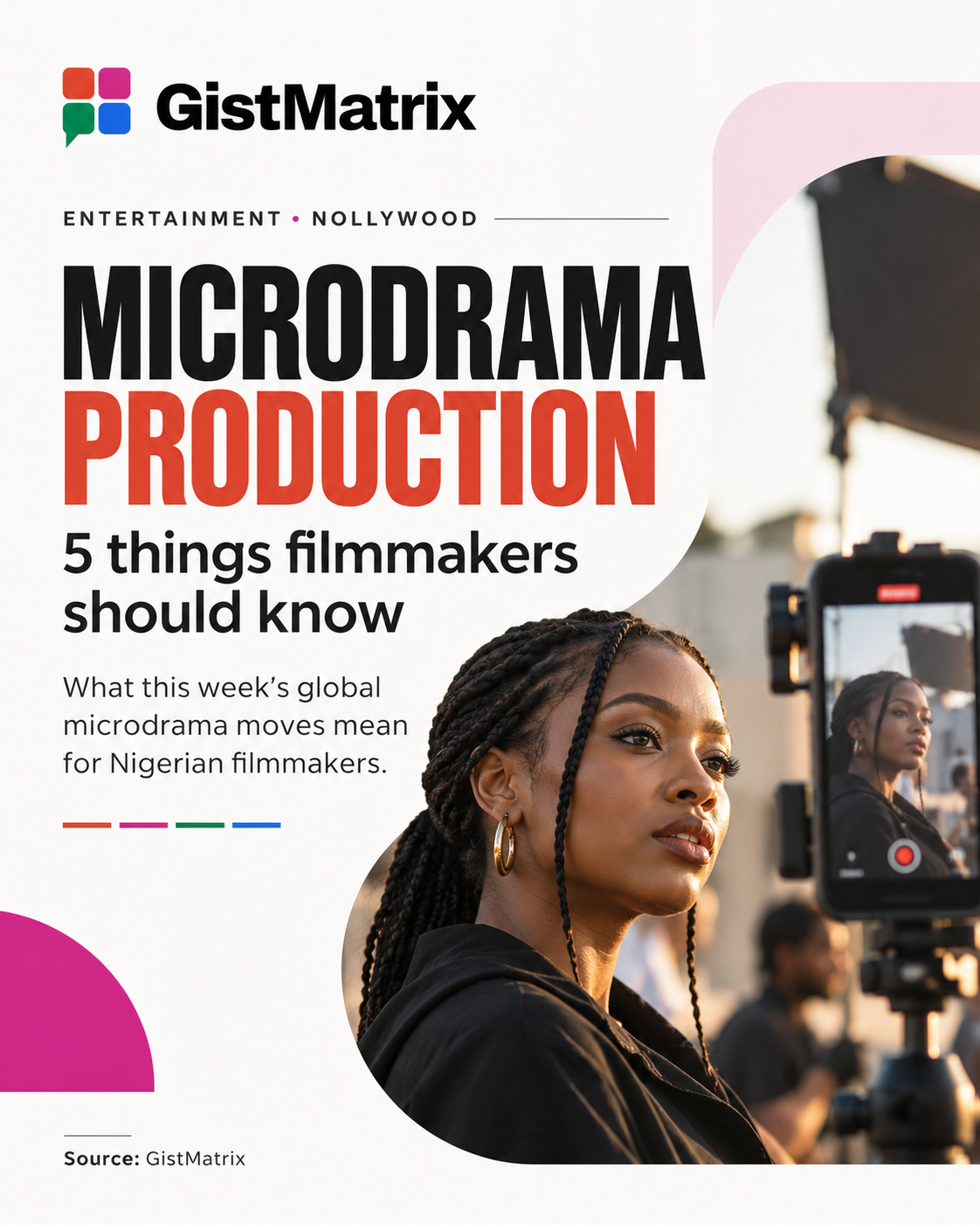
Microdrama production: 5 things filmmakers should know this week
A toy company, a British broadcaster, an Indian app and TikTok all moved this week. Here is what the latest microdrama news means for filmmakers, in five lessons.
By John Christian Mmaduabuchi, Chief Editor
· · 7 min read · Lagos
- TikTok owner ByteDance's free, ad-funded PineDrama app has passed 100 million downloads in under a year, and mostly shows locally produced dramas with 60–90 second episodes.
- Brands are commissioning microdramas directly: VTech released a 12-episode series on Friday, and Channel 4's first vertical drama, made with Sol de Janeiro, premieres on 24 October.
- In China, about 430,000 microdramas launched in eight months, mostly made with AI, but fewer than 1.3% of AI titles broke even; a strong hook, cliffhangers and a marketing budget still decide success.
The gist in 30 seconds
- TikTok owner ByteDance's free, ad-funded PineDrama app has passed 100 million downloads in under a year, and mostly shows locally produced dramas with 60–90 second episodes.
- Brands are commissioning microdramas directly: VTech released a 12-episode series on Friday, and Channel 4's first vertical drama, made with Sol de Janeiro, premieres on 24 October.
- In China, about 430,000 microdramas launched in eight months, mostly made with AI, but fewer than 1.3% of AI titles broke even; a strong hook, cliffhangers and a marketing budget still decide success.
Ninety seconds. That is about how long a microdrama episode gets to hook a viewer, land a twist and leave them desperate for the next one.
In the past few days, the business built on those ninety seconds has moved again. A toy company released a 12-part series. A British broadcaster handed its first vertical drama to a perfume brand. India’s ShareChat made the products in a scene buyable while the scene plays. TikTok’s drama app crossed 100 million downloads. And new figures from China showed how hard it is to make money even when artificial intelligence makes the shows almost free.
Nigerian filmmakers have already seen what the format can do: the home-grown Billion Naira Bride passed 25 million views on TikTok in its first four days in August. Here are five things this week’s news says about microdrama production right now, and what each one means for you.
1. Free microdrama apps want local stories
PineDrama, the short-drama app from TikTok’s owner, ByteDance, has passed 100 million downloads less than a year after it launched in late 2025, with about 7 million people using it every day, Caixin reported this week. It started in markets including the United States, Brazil and Indonesia.
Its model is the opposite of the apps that made microdramas famous. ReelShort and DramaBox charge viewers to unlock episodes, and each made more than $120 million from in-app purchases in the first half of 2026. On PineDrama, viewers do not buy a membership: watching ads unlocks the episodes. And most of what it shows is locally produced, with episodes of 60 to 90 seconds, rather than dubbed or subtitled Chinese imports.
What it means: the next wave of platforms needs stories that feel local to their audiences. A Lagos love story with a Lagos cast is not a niche product; it is exactly what a free, ad-funded app needs to keep a market watching.
2. Brands are now commissioning microdramas
On Friday, the toy maker VTech released The Greatest Band in the Galaxy, a 12-episode micro-series made with the agency Mod Op. Each episode runs 60 to 90 seconds and ends on a cliffhanger, and all of them went up at once on YouTube, TikTok and Instagram. Its toys are part of the story rather than an advert in the break.
In Britain, Channel 4 has commissioned its first vertical drama, The Guest List, in partnership with the beauty brand Sol de Janeiro. The five-part series follows four young working women in London, among them characters named Amaka and Aisha, and each character is inspired by one of the brand’s scents. It premieres on 24 October on Channel 4’s TikTok, YouTube and Meta channels.
What it means: a platform is no longer the only buyer. A producer with a strong idea can pitch a brand directly, as long as the product fits the story naturally. Audiences scroll away from anything that feels like an advert.
3. The scene itself can sell
In India, ShareChat and Moj have launched a format called Shop the Scene, which lets viewers buy products they see in a microdrama while they watch. It works with two large e-commerce companies, which have not been named. The platforms also run campaigns in which actors show products that fit the storyline between episodes, often at the cliffhanger. ShareChat says its microdramas now get more than 1 billion episode views a day across its network.
What it means: wardrobe, props and locations are now possible sources of income, and the deals start at the script stage. The cliffhanger, the moment viewers care most, is also the most valuable moment for a sponsor.
4. AI makes microdramas cheap, but hits are still rare
China, where the format was born, shows the risk. About 430,000 microdramas launched on Chinese platforms between January and August 2026, 13 times the total for the whole of last year, and more than 90% were made with AI, according to industry data compiled by BigGo Finance from sources including DataEye. Yet fewer than 1.3% of the AI dramas released in the first half reached the 50 million views the industry treats as break-even. Buying an audience through advertising swallows 70% to 90% of what viewers pay, and the income from every 10,000 views has fallen sharply in a year.
What it means: cheaper production is not the same as a business. The things that still decide whether a series works are the hook in the first seconds, the twist at the end of each episode and a plan, and a budget, for getting it in front of viewers.
5. Creators with audiences are the new leads
TikTok has signed its second big microdrama deal, a multi-year slate with Made By Us Studios for TikTok and PineDrama. The first two series, Player and The Knock, are built around the social media creators Hannah Stocking and Adam Rose, with the musician Moby scoring The Knock. It follows TikTok’s micro-series Screen Time with Issa Rae’s company Hoorae, which has drawn nearly 580 million views. In the US, the actors’ union SAG-AFTRA now has an agreement for vertical productions, a sign the format is becoming a proper industry with proper terms.
What it means: a creator who already has an audience brings viewers on day one. Skits are one of Nigeria’s biggest creative strengths, and skits already pull huge numbers for Nollywood stars. Casting a creator with a loyal following can be the difference between a series that is seen and one that is not.
Microdrama production basics: the format in numbers
If you are planning your first series, these are the numbers the industry works to:
- Shape: vertical, 9:16, made to be watched on a phone.
- Episode length: usually 60 to 90 seconds, rarely more than about two minutes.
- Series length: often 50 episodes or more. Billion Naira Bride ran to 60.
- Structure: a hook in the opening seconds and a cliffhanger at the end of every episode.
- Money: pay-per-episode apps (ReelShort, DramaBox), free apps funded by ads (PineDrama), brand-funded series (VTech, Channel 4) and shoppable scenes (ShareChat).
What it means for Nollywood
Nigeria is not starting from zero. Billion Naira Bride, starring Aderonke Onuoha and Jay Charles Ujomu, was released on the LunarticksUSCA short-drama channel on TikTok and passed 25 million views in four days. The Lagos-based Digital Creator Africa Academy, co-founded by Ifeoma ‘Oma’ Areh and Elijah Affi, set out this year to train 300 filmmakers, videographers and writers in vertical storytelling.
This week’s news adds the rest of the picture: more buyers, more ways to make money, and a warning that cheap shows are not enough. The filmmakers who win will be the ones who treat ninety seconds as seriously as ninety minutes.
Are you making a microdrama in Nigeria? Tell GistMatrix about it.
Microdrama production: quick answers
What is a microdrama?
A microdrama is a scripted series of very short episodes, filmed vertically for phones, with a cliffhanger at the end of each episode. The format started in China, where it is called duanju.
How long is a microdrama episode?
Usually 60 to 90 seconds, and rarely more than about two minutes.
How many episodes does a microdrama have?
Often 50 or more. The Nigerian hit Billion Naira Bride has 60.
How do microdramas make money?
Through apps that charge viewers to unlock episodes, free apps funded by ads, brand-funded series, and shopping features that let viewers buy what they see in a scene.
Can Nigerian filmmakers make microdramas?
Yes. Billion Naira Bride showed there is a big audience for Nigerian microdramas on TikTok, and training programmes such as the Digital Creator Africa Academy are preparing more Nigerian filmmakers for the format.
Related on GistMatrix: From screenplay to top 10: how The God Weaver found its readers · New on Netflix Naija this week: The Diplomat leads 10 to stream
Sources
We checked this story against these sources. How we check
- Caixin Global: ByteDance's PineDrama tops 100 million downloads in global short-drama push (16 Oct 2026)
- BigGo Finance: PineDrama tops 100 million downloads in 9 months (12 Oct 2026)
- VTech Electronics North America: VTech debuts original micro-series The Greatest Band in the Galaxy (16 Oct 2026)
- Channel 4: Channel 4 commissions its first vertical drama series, in partnership with Sol de Janeiro (13 Oct 2026)
- Indian Television: ShareChat and Moj launch interactive ad formats as microdrama views top 1 billion (15 Oct 2026)
- BigGo Finance: Behind the explosive growth of AI short dramas, citing DataEye and others (14 Oct 2026)
- TikTok and Made By Us Studios: microdrama slate, as reported by Deadline (14 Oct 2026)
- The Guardian Nigeria: Billion Naira Bride signals Africa's microdrama future (14 Aug 2026)
- C21Media: Nigerian initiative DCAA aims to put Africa at centre of microdrama boom (9 Feb 2026)
How does this story make you feel?

John Christian Mmaduabuchi is a Nigerian filmmaker, creative director, and media professional with extensive experience in digital storytelling, visual journalism, and contemporary media. His Journalism interests span Nigerian and African current affairs, entertainment, culture, technology, lifestyle, media, and the people shaping public conversation. With a background in film direction and documentary production, he brings a strong visual and narrative perspective to editorial work, with particular attention to context, clarity, and compelling storytelling. John is also a creative entrepreneur focused on storytelling, entertainment, culture, and digital content. His professional experience across directing, cinematography, editing, media strategy, and emerging AI technologies gives him a broad understanding of how stories are created, distributed, and consumed in the digital age. At GistMatrix, John contributes to the development and presentation of timely, engaging, and relevant stories for a contemporary audience. His approach to editorial work is grounded in accuracy, context, responsible storytelling, and a commitment to covering stories that matter.
Join the conversation
Be sharp, be kind. Comments are checked before they appear. We remove insults, hate, spam and personal details. Community rules