Reps bill would bar Abuja landlords from demanding more than a year’s rent upfront
A bill before the House of Representatives would cap compulsory advance rent in the FCT at 12 months, with fines of up to ₦20m. What it says, how it compares with Lagos and what happens next.
By John Christian Mmaduabuchi, Chief Editor
· 5 min read · Abuja
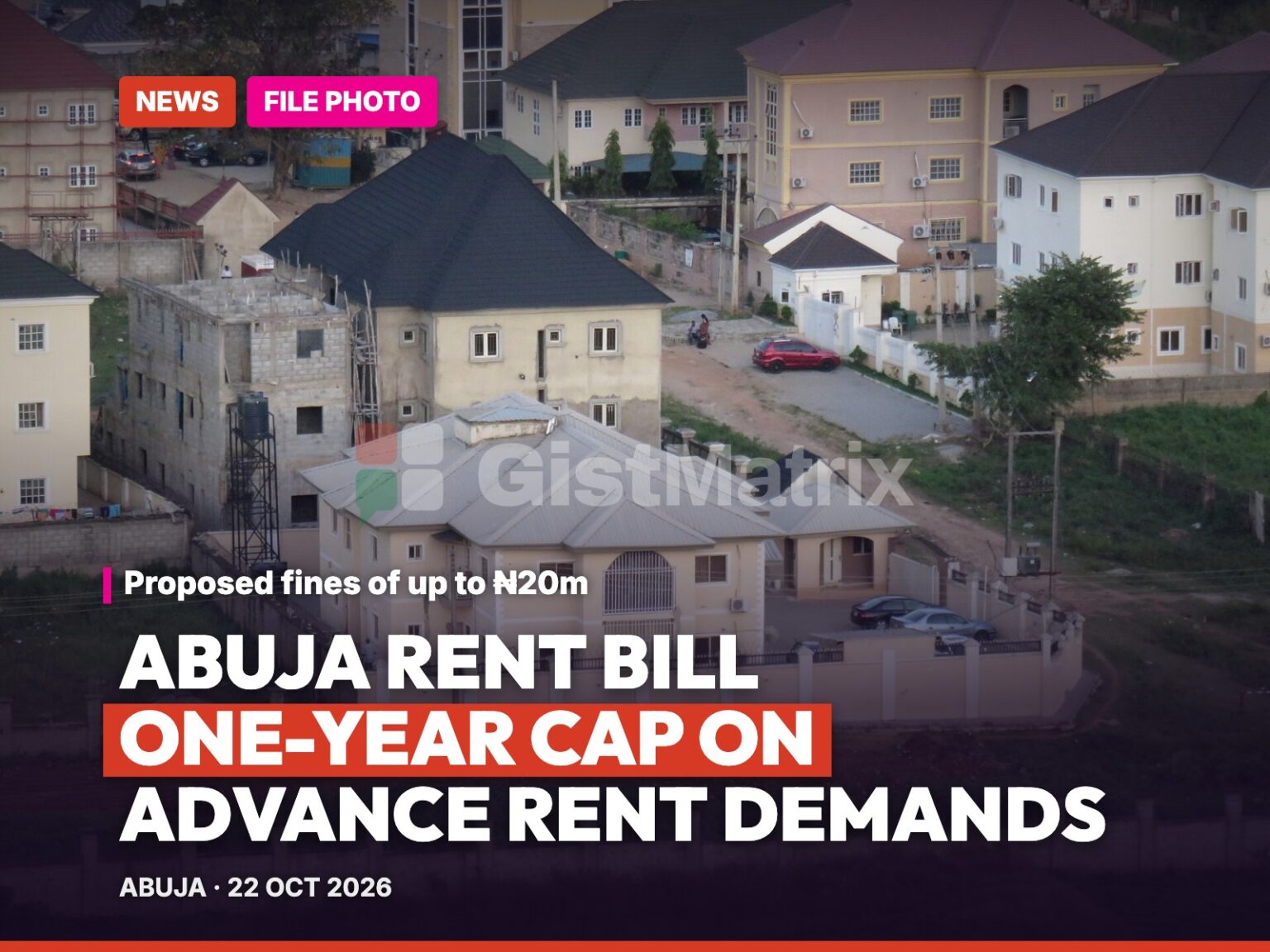
- A bill before the House of Representatives would bar landlords and agents in the FCT from demanding more than 12 months’ rent in advance, Premium Times and TheCable reported on Thursday, 22 October 2026.
- Under the proposal, individuals who knowingly break the cap could be fined between ₦500,000 and ₦5 million, and companies between ₦5 million and ₦20 million.
- The bill passed first reading on Thursday, 22 October 2026, and still needs second and third readings, Senate approval and the President’s assent to become law.
The gist in 30 seconds
- A bill before the House of Representatives would bar landlords and agents in the FCT from demanding more than 12 months’ rent in advance, Premium Times and TheCable reported on Thursday, 22 October 2026.
- Under the proposal, individuals who knowingly break the cap could be fined between ₦500,000 and ₦5 million, and companies between ₦5 million and ₦20 million.
- The bill passed first reading on Thursday, 22 October 2026, and still needs second and third readings, Senate approval and the President’s assent to become law.
Landlords and agents in Abuja would be barred from forcing tenants to pay more than 12 months’ rent in advance under a bill now before the House of Representatives, according to copies of the bill described by Premium Times and TheCable on Thursday, 22 October 2026.
The Federal Capital Territory Advance Rent Regulation and Tenants’ Protection Bill, 2026 (HB.2839) passed first reading in the House on Thursday, Premium Times reported. It is sponsored by Paul Nnamchi, who represents Enugu East/Isi-Uzo, with Ahmed Doro, who represents Bindawa/Mani in Katsina State, as co-sponsor.
Why it matters
Finding one or two years’ rent in one go, on top of agency, agreement and caution fees, is one of the heaviest costs of renting in the capital. Premium Times reported in July 2025 that FCT residents were struggling with rising rents and sharp increases in those fees, with some moving to cheaper areas further from work.
The bill goes straight at that lump sum. It is only a proposal for now, and it has several stages to clear before it can become law.
What does the bill say?
- The cap: a landlord, estate agent, property manager or anyone acting for a landlord could not demand, receive or compel a tenant to pay more than 12 months’ rent in advance as a condition for granting, renewing or continuing a tenancy.
- Homes and businesses: it would cover both residential and commercial tenancies in the FCT, according to Premium Times.
- No loopholes: landlords could not get round the cap through intermediaries, compulsory service charges, artificial renewals, separate agreements or similar arrangements, TheCable reported.
- Paying more by choice: a tenant could still pay for more than a year, but only if the tenant starts the offer, without coercion, threats or retaliation, and the arrangement is put in writing.
- Written agreements: landlords and agents would have to give tenants a written agreement setting out the rent, payment schedule, length of the tenancy, refundable deposits and any other charges.
Who would enforce it, and what are the penalties?
The bill would set up a Federal Capital Territory Rent Regulation and Tenants’ Protection Authority. According to the two reports, it could investigate complaints, monitor landlords and agents, issue compliance notices, help settle disputes, keep a public register of letting agents and order the refund of an unlawful payment within 30 days.
A person who knowingly demands or receives more than the permitted advance rent could be fined between ₦500,000 and ₦5 million, and a company between ₦5 million and ₦20 million. Ignoring a valid compliance notice could bring a fine of up to ₦1 million, and anyone unhappy with the authority’s decision could appeal to the FCT High Court within 30 days, TheCable reported.
The bill would also ban “self-help” evictions, such as threats, cutting off essential services, removing a tenant’s belongings or changing the locks without lawful authority. Landlords would keep the right to recover rent that is due and to take back their property through the courts, Premium Times reported.
How does it compare with Lagos?
Lagos already has a similar rule. Under the Lagos State Tenancy Law of 2011, it is unlawful for a landlord or agent to demand or receive more than a year’s rent from a new tenant, or more than six months from a sitting monthly tenant. The penalty is a fine of ₦100,000 or three months in prison. The Lagos law also makes it an offence for the tenant to offer or pay more, and it does not apply in Apapa, Ikeja GRA, Ikoyi and Victoria Island.
The Abuja bill takes a different line. It would punish the landlord or agent rather than the tenant, and would allow a tenant to pay more if the tenant chooses to and the deal is documented.
Has this been tried before?
Yes. In 2022, a Senate bill sponsored by Smart Adeyemi, then senator for Kogi West, sought to cut advance rent in the FCT to three months, followed by monthly payments. It passed second reading in the Senate, Channels Television reported at the time, but it was not passed into law.
Last year, the National Assembly also proposed capping rent increases across the country at 20 per cent and urged the federal government to enforce it. TheCable said the resolution has not been verifiably implemented.
What happens next
- Second reading: the House will debate the bill’s general principles. If it passes, it goes to a committee, which can hold a public hearing for landlords, agents and tenants.
- Third reading, Senate and assent: the House must pass it at third reading, the Senate must agree to it and the President must sign it before it becomes law.
- Until then: the bill has no legal force, and current tenancy agreements in the FCT are unaffected.
Are you renting in Abuja? Tell GistMatrix how much rent you were asked to pay upfront, and what you think of the bill.
Sources
We checked this story against these sources. How we check
- Premium Times: Reps consider bill to ban compulsory multi-year advance rent in FCT (22 Oct 2026)
- TheCable: Reps move to prohibit landlords from demanding more than one year’s rent in Abuja (22 Oct 2026)
- LawPàdí: 10 Things Lagosians should know about the Lagos Tenancy Law (accessed 22 Oct 2026)
- Channels Television: Bill to stop yearly house rent in Abuja scales second reading (1 Feb 2022)
How does this story make you feel?

John Christian Mmaduabuchi is a Nigerian filmmaker, creative director, and media professional with extensive experience in digital storytelling, visual journalism, and contemporary media. His Journalism interests span Nigerian and African current affairs, entertainment, culture, technology, lifestyle, media, and the people shaping public conversation. With a background in film direction and documentary production, he brings a strong visual and narrative perspective to editorial work, with particular attention to context, clarity, and compelling storytelling. John is also a creative entrepreneur focused on storytelling, entertainment, culture, and digital content. His professional experience across directing, cinematography, editing, media strategy, and emerging AI technologies gives him a broad understanding of how stories are created, distributed, and consumed in the digital age. At GistMatrix, John contributes to the development and presentation of timely, engaging, and relevant stories for a contemporary audience. His approach to editorial work is grounded in accuracy, context, responsible storytelling, and a commitment to covering stories that matter.




Join the conversation
Be sharp, be kind. Comments are checked before they appear. We remove insults, hate, spam and personal details. Community rules