SEC targets ₦750trn capital market by 2036: what the new plan means for you
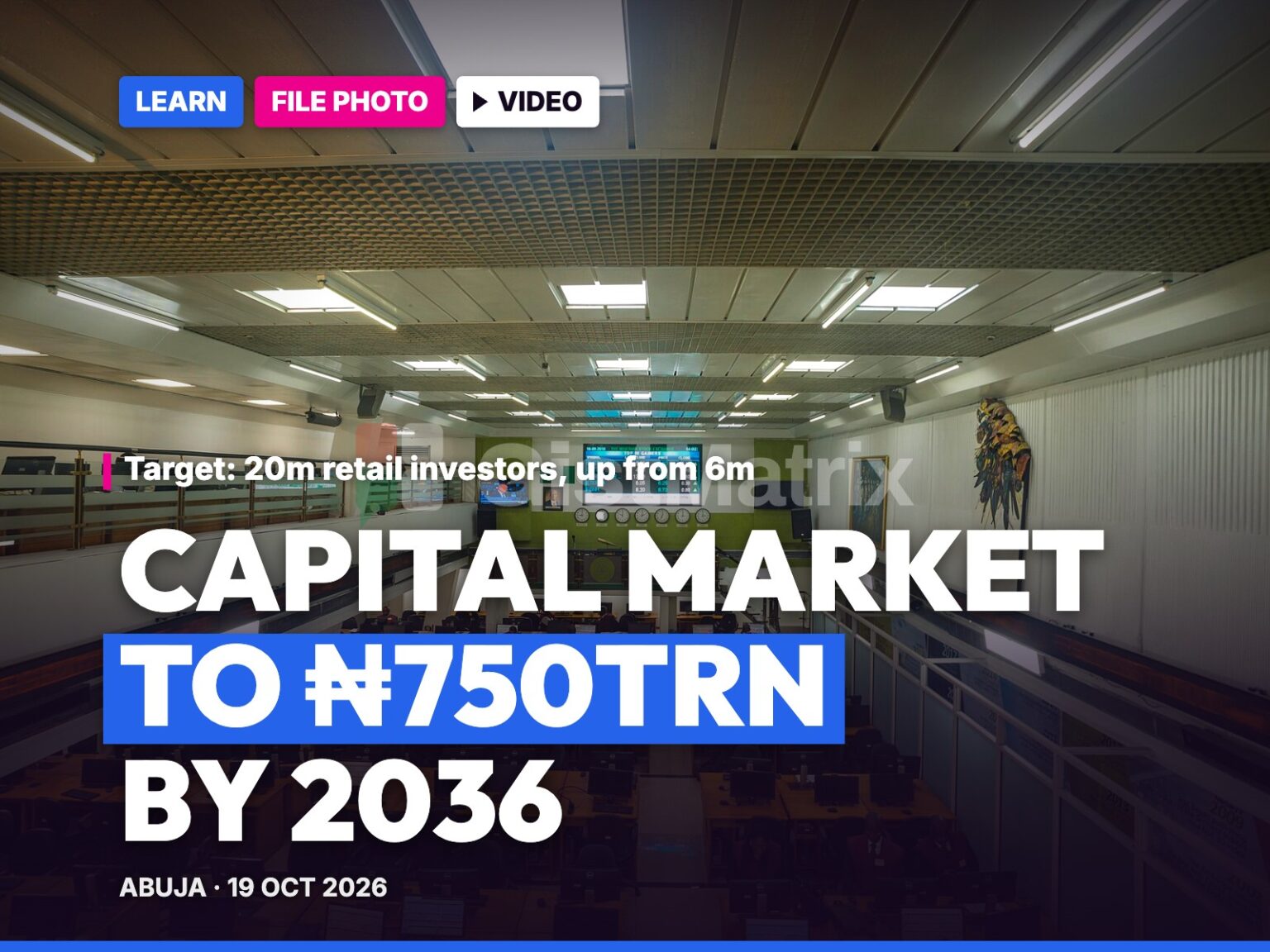
A 10-year plan launched in Abuja aims to triple Nigeria's capital market and lift retail investors from six million to 20 million, with a new National Savings Scheme for small savers.
By John Christian Mmaduabuchi, Chief Editor
· Video · Abuja
The gist in 30 seconds
- The SEC launched the Nigerian Capital Market Master Plan 2.0 at the Presidential Villa, Abuja, on Monday, 19 October 2026, targeting a ₦750 trillion market by 2036, up from about ₦250 trillion.
- The Minister of Finance, Taiwo Oyedele, set targets of 20 million retail investors, up from six million, and 250 listed companies, up from 146.
- A National Savings Scheme launched the same day will be run by SEC-registered fund managers with tax incentives, but its minimum contribution and sign-up date were not given.
The Securities and Exchange Commission (SEC) has launched a 10-year plan to triple the size of Nigeria’s capital market to ₦750 trillion by 2036, together with a National Savings Scheme for people who want to save and invest small amounts. Both were launched at the National Capital Market Conference 2026 at the Presidential Villa, Abuja, on Monday, 19 October 2026.
The capital market is where companies and governments raise long-term money by selling shares and bonds, and where savers can own a piece of them. Very few Nigerians take part. “We have only six million retail investors in a country of over 240 million people,” the Minister of Finance and Coordinating Minister of the Economy, Taiwo Oyedele, told the conference. The plan aims to more than triple that number.
What is in the plan?
The Nigerian Capital Market Master Plan 2.0, covering 2026 to 2036, was drawn up by the SEC. Its Director-General, Emomotimi Agama, said it aims to grow the market from a baseline of about ₦250 trillion to ₦750 trillion. Oyedele set out the main targets:
- Retail investors: from six million to 20 million.
- Listed companies: from 146 to 250.
- Shares: the value of listed shares to rise from 33% of the size of the economy (GDP) to at least 60%.
- Pensions: pension assets, now ₦27.5 trillion, to rise from 6% of GDP to 16%.
- Bonds and sukuk: corporate bond issuance to more than triple as a share of GDP, and sukuk, Islamic bonds, to grow from 0.3% of GDP to at least 5%.
“Every commitment in NCMMP 2.0 will have an owner, a timeline and a scorecard,” Agama said. The conference programme included the inauguration of a steering committee and an implementation committee for the plan.
Senator Ibrahim Hassan Hadejia, Deputy Chief of Staff to the President, who spoke for Vice-President Kashim Shettima, said: “The capital market is a bridge between the savings of Nigerians and the investment Nigeria needs.”
What is the National Savings Scheme?
Oyedele launched the scheme as a regulated way for Nigerians, including traders, farmers and young graduates, to save and invest for education, housing, business and retirement. He described small contributions made by mobile phone, reasonable costs and a working complaints process.
- Who manages the money: professional fund managers registered with the SEC.
- The law behind it: the Investments and Securities Act 2025.
- Tax incentives: to be provided under an agreement between the SEC, the Nigeria Revenue Service and FSD Africa. Oyedele said the incentives would follow the law, be properly costed and be run transparently.
“The strength of any capital market rests on the savings of its people,” Agama said.
The reports of the launch did not give a minimum contribution, the size of the tax incentive or a date when savers can sign up. Those are the details that will decide whether the scheme is worth joining.
Will NNPC and NLNG be listed?
The government wants them to be. “NNPC, NLNG, those choice assets of government have to be listed,” Oyedele said, adding that the government would lead a clean-up of NNPC before any listing. No date for a listing was given in reports of the conference.
Private companies will not be forced. “We cannot force them. We would encourage Nigerian private businesses to list. We will use incentives to attract them,” he said. The chairman of the Senate Committee on Capital Market, Senator Osita Izunaso, urged the government to encourage NNPC and the big telecoms companies to list on the Nigerian Exchange.
What would tripling take? A GistMatrix calculation
Using only the figures given at the conference:
- Going from ₦250 trillion to ₦750 trillion in 10 years means growing by about 11.6% a year, every year. Because the target is in naira, some of that growth would come from rising prices rather than new investment.
- Adding 14 million retail investors means about 1.4 million new investors a year, or roughly 3,800 a day.
- Going from 146 to 250 listed companies means about 10 new listings a year.
- On Oyedele’s figure of 240 million people, about one Nigerian in 40 is a retail investor today. At 20 million, it would be about one in 12.
Why now?
The market has had a strong run. Agama said the value of listed shares first crossed ₦100 trillion in January and rose above ₦160 trillion in September, and that the All-Share Index has gained about 60% in 2026 after 51% in 2025. Oyedele said Nigeria was reinstated in the FTSE Russell Frontier Market Index on 21 September.
He also warned against reading too much into rising prices. “Higher share prices alone do not transform an economy,” he said.
The plan also promises stronger action against Ponzi schemes and a proposed way to compensate victims of fraud. Until the scheme’s rules are published, the usual rule applies: check that any firm is registered with the SEC before handing over money.
What happens next
- The savings scheme’s details: watch for the minimum contribution, the tax incentive and how to sign up.
- The committees: the steering and implementation committees now have to turn the targets into yearly milestones.
- NNPC and NLNG: watch for any timetable for listing them on the Nigerian Exchange.
The video with this story is NTA’s report on the launch.
Have you tried to buy shares or put money in a mutual fund, or would you join the new savings scheme? Tell GistMatrix what would make you invest.
Sources
We checked this story against these sources. How we check
- Securities and Exchange Commission: National Capital Market Conference 2026, programme notice (Oct 2026)
- Daily Trust: Nigeria targets N750trn capital market in 10 years (20 Oct 2026)
- Arise News: Nigeria Targets N750trn Capital Market, Unveils 10-Year Growth Plan (20 Oct 2026)
- BusinessDay: Nigeria's SEC eyes N750trn capitalisation by 2036 as Senate urges NNPC, telecom firms to list on NGX (19 Oct 2026)
- Vanguard: FG targets N750trn stock market with NNPC, NLNG listing (20 Oct 2026)
- Nairametrics: Taiwo Oyedele pushes for NNPCL, NLNG listing to boost transparency, wealth creation (19 Oct 2026)
- The Guardian Nigeria: Shettima unveils capital market masterplan as SEC targets N750tr (20 Oct 2026)
- NTA Live (YouTube): Nigeria Targets ₦750 Trillion Capital Market by 2036 as Shettima Unveils New Roadmap (20 Oct 2026)
- GistMatrix: calculation of the growth needed to meet the plan's targets, from figures given at the conference (20 Oct 2026)
How does this story make you feel?

John Christian Mmaduabuchi is a Nigerian filmmaker, creative director, and media professional with extensive experience in digital storytelling, visual journalism, and contemporary media. His Journalism interests span Nigerian and African current affairs, entertainment, culture, technology, lifestyle, media, and the people shaping public conversation. With a background in film direction and documentary production, he brings a strong visual and narrative perspective to editorial work, with particular attention to context, clarity, and compelling storytelling. John is also a creative entrepreneur focused on storytelling, entertainment, culture, and digital content. His professional experience across directing, cinematography, editing, media strategy, and emerging AI technologies gives him a broad understanding of how stories are created, distributed, and consumed in the digital age. At GistMatrix, John contributes to the development and presentation of timely, engaging, and relevant stories for a contemporary audience. His approach to editorial work is grounded in accuracy, context, responsible storytelling, and a commitment to covering stories that matter.


Join the conversation
Be sharp, be kind. Comments are checked before they appear. We remove insults, hate, spam and personal details. Community rules