World Bank papers show $500m Nigeria infrastructure loan pencilled in for May 2027
A World Bank document read by GistMatrix sets 25 May 2027 as the estimated approval date for a $500m loan for INFRAGROW, a planned NSIA-run platform to draw $3.85bn into infrastructure.
By John Christian Mmaduabuchi, Chief Editor
· 4 min read · Abuja
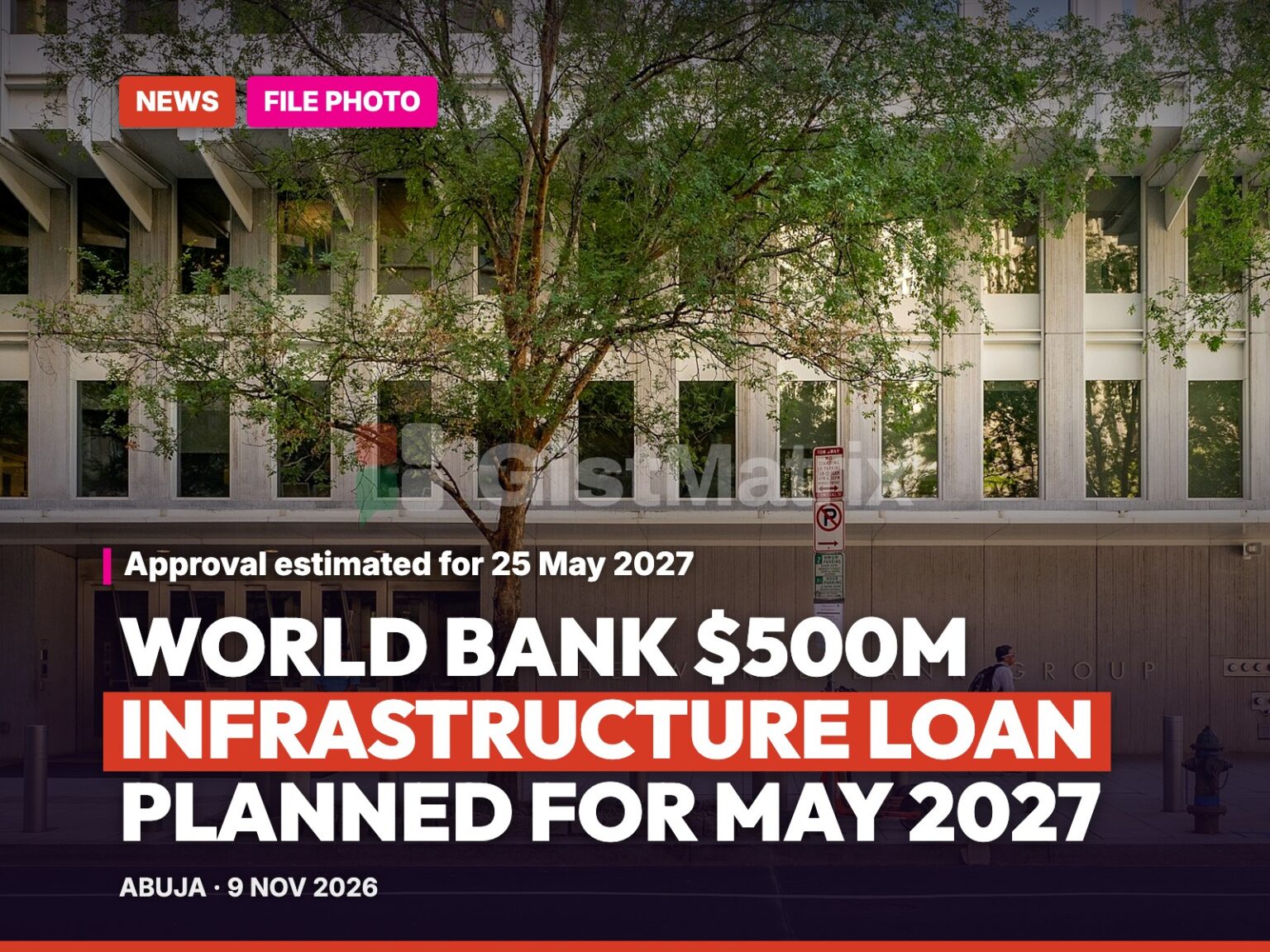
- A World Bank document dated 4 November 2026 sets 25 May 2027 as the estimated approval date for a $500m loan for Nigeria's planned INFRAGROW infrastructure platform.
- The loan, $400m from IBRD and $100m from IDA, is part of a $3.85bn plan that also counts on NSIA equity, private investors, commercial debt and $2.35bn of guarantees.
- The World Bank rates the project's environmental and social risk as high because of the energy, transport and water projects it could finance.
The gist in 30 seconds
- A World Bank document dated 4 November 2026 sets 25 May 2027 as the estimated approval date for a $500m loan for Nigeria's planned INFRAGROW infrastructure platform.
- The loan, $400m from IBRD and $100m from IDA, is part of a $3.85bn plan that also counts on NSIA equity, private investors, commercial debt and $2.35bn of guarantees.
- The World Bank rates the project's environmental and social risk as high because of the energy, transport and water projects it could finance.
The World Bank is preparing a $500 million loan for a new Nigerian infrastructure financing platform, and its own planning papers put the estimated date for board approval at Tuesday, 25 May 2027, four days before the next presidential inauguration. GistMatrix read the bank’s initial project information document for the scheme, called INFRAGROW, which is dated Wednesday, 4 November 2026, and published on the World Bank’s documents website.
The PUNCH was first to report the document. The loan has not been approved, and the approval date in the document is an estimate.
Why it matters
Nigeria’s infrastructure financing gap is about $100 billion a year, according to the World Bank document, which says the gap “remains a binding constraint on growth, fiscal sustainability, competitiveness, and job creation”.
The Federal Ministry of Finance is named as the borrower, so the money would be a loan to the federal government. But it is not money for a single road or power station. It is meant to set up and run a group of financing companies that would help projects attract investors such as banks, pension funds, insurers and foreign lenders.
What the World Bank document says
The project’s full name is the Nigeria Infrastructure Financing and De-Risking Platform for Growth and Jobs (INFRAGROW). The Nigeria Sovereign Investment Authority (NSIA) is the implementing agency. The bank states the aim as “to mobilize private capital for sustainable infrastructure investment in Nigeria”.
The document describes four companies under one holding company, each meant to tackle a different reason investors stay away:
- Project Preparation Facility: pays for feasibility studies, deal structuring and procurement support, to turn ideas into projects that investors can fund.
- Viability Gap Fund: supports needed projects that cannot pay their way at affordable tariffs. The bank proposes an endowment that would fund this support mainly from investment returns.
- Risk Capital Facility: takes minority equity and other patient capital in commercially viable projects that are short of risk-bearing money.
- Credit Guarantee Vehicle: offers guarantees against loan defaults and government payment failures and, through political risk insurance from MIGA, the World Bank Group’s insurance arm, cover for some non-commercial risks faced by foreign investors.
Where the $3.85bn would come from
A GistMatrix breakdown of the document’s financing table shows that the World Bank’s own money is $500 million of the $3.85 billion total: $400 million from its IBRD lending arm and $100 million from IDA, its fund for the poorest countries.
The rest is expected from others, according to the document:
- $200 million in equity from the NSIA, as founding shareholder;
- $200 million in private-sector equity;
- $600 million in commercial debt;
- a $100 million IDA payment guarantee;
- $2.25 billion in guarantees from other international financial institutions.
That means $2.35 billion, more than half of the headline figure, is guarantees rather than cash lent up front. The document says the International Finance Corporation (IFC), the bank’s private-sector arm, is envisaged as a co-anchor investor.
What are the risks?
The World Bank rates the project’s environmental and social risk as “High”. It says the main risk is not the platform itself but the projects it would finance in energy, transport and water, which could involve large civil works, land acquisition and resettlement, and harm to communities and workers.
The document also notes that the platform’s subsidiaries are still to be built, describing their institutional status as “a significant capacity gap” that the bank’s support is meant to address.
Why the timing has drawn attention
The estimated approval date falls four days before the inauguration on Saturday, 29 May 2027, of the president elected next year. The document sets Thursday, 21 January 2027, for the bank’s technical design review. The IDA guarantee is due to be signed on 30 June 2027 and to expire on 31 December 2042, so the commitments would run well beyond the current presidential term.
The NSIA has already begun procurement for the platform. It invited expressions of interest from firms to provide legal advice on INFRAGROW, with a deadline of 4 November 2026, according to a notice listed on the eTenders procurement site under reference NSIA/LA/EOI/NIFG/2026/001.
What happens next
The project is at an early stage. Under the bank’s timetable, the technical design review is due on 21 January 2027 and board approval is estimated for 25 May 2027. Dates in an initial project information document are estimates and can change as preparation continues.
GistMatrix will follow the project as the World Bank publishes more documents. Do you work on an infrastructure project that cannot find investors? Tell GistMatrix.
Sources
We checked this story against these sources. How we check
- World Bank: Initial Project Information Document (PID), Nigeria Infrastructure Financing and De-Risking Platform for Growth and Jobs (INFRAGROW) Project, P519064 (4 Nov 2026)
- eTenders: NSIA expression of interest for legal advisory services for INFRAGROW, ref. NSIA/LA/EOI/NIFG/2026/001 (21 Oct 2026)
- THEWILL: FG Seeks $500m World Bank Loan for $3.85bn Infrastructure Platform Ahead of 2027 Handover (9 Nov 2026)
How does this story make you feel?

John Christian Mmaduabuchi is a Nigerian filmmaker, creative director, and media professional with extensive experience in digital storytelling, visual journalism, and contemporary media. His Journalism interests span Nigerian and African current affairs, entertainment, culture, technology, lifestyle, media, and the people shaping public conversation. With a background in film direction and documentary production, he brings a strong visual and narrative perspective to editorial work, with particular attention to context, clarity, and compelling storytelling. John is also a creative entrepreneur focused on storytelling, entertainment, culture, and digital content. His professional experience across directing, cinematography, editing, media strategy, and emerging AI technologies gives him a broad understanding of how stories are created, distributed, and consumed in the digital age. At GistMatrix, John contributes to the development and presentation of timely, engaging, and relevant stories for a contemporary audience. His approach to editorial work is grounded in accuracy, context, responsible storytelling, and a commitment to covering stories that matter.



Join the conversation
Be sharp, be kind. Comments are checked before they appear. We remove insults, hate, spam and personal details. Community rules