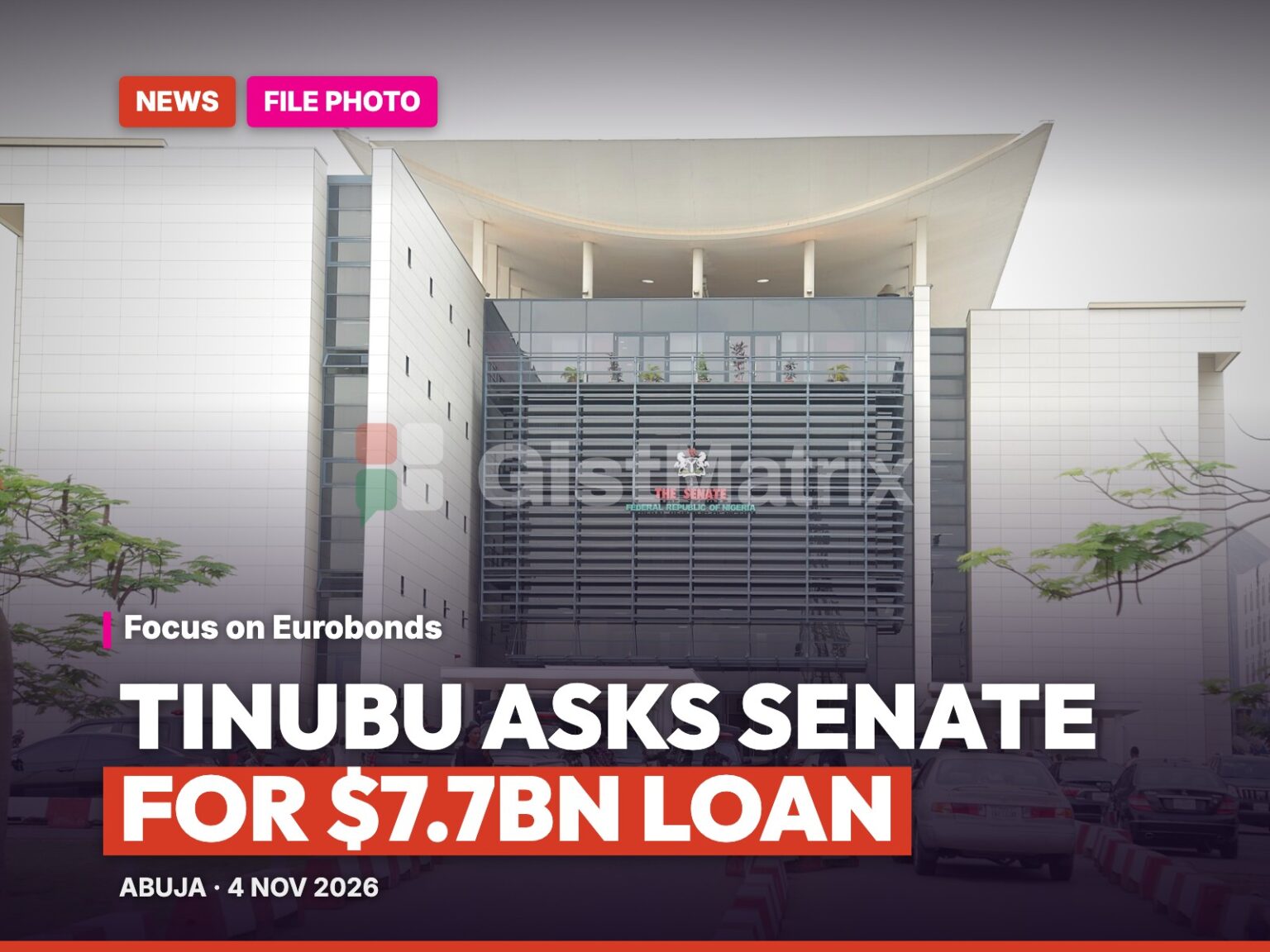
Tinubu asks Senate to approve $7.7bn external loan, mainly through Eurobonds
President Bola Tinubu has asked the Senate to approve about $7.7 billion of foreign borrowing for the 2026 budget, mainly through Eurobonds. Here is what it means.
By John Christian Mmaduabuchi, Chief Editor
· Video · Abuja
The gist in 30 seconds
- President Bola Tinubu asked the Senate on Wednesday, 4 November 2026, to approve about $7.7 billion of external borrowing for the 2026 budget.
- The President said the focus would be on Eurobonds, and the new letter replaces a request of about $20.5 billion and €1.05 billion sent last week.
- A GistMatrix check of CBN data shows $7.7 billion is worth about ₦10.39 trillion at Wednesday's official rate, below the budget's ₦10.79 trillion.
President Bola Tinubu has asked the Senate to approve about $7.7 billion of new external borrowing to fund part of the 2026 budget deficit, in a letter read by the Senate President, Godswill Akpabio, at plenary in Abuja on Wednesday, 4 November 2026. The President said most of the money would be raised by selling Eurobonds.
The request, for $7,707,404,882.49, matches the ₦10.79 trillion of foreign borrowing in the 2026 Appropriation Act at the budget exchange rate of ₦1,400 to the dollar, Premium Times and Business Post reported. It takes the place of a much larger request for external loans of about $20.5 billion and €1.05 billion that the Senate received last week.
Why it matters
Borrowing abroad brings dollars into the country, but the loans have to be repaid in dollars, with interest, for years to come. The President said the money would be received by the Central Bank of Nigeria (CBN) on the government’s behalf and would also support the external reserves, the News Agency of Nigeria (NAN) reported. What the loans cost, and what the money is spent on, will shape how much of the government’s revenue goes on debt service in the years ahead.
What did the President ask for?
In the letter, Mr Tinubu recalled that the 2026 Appropriation Act provided for ₦29.2 trillion of new borrowing to finance a deficit of about ₦31.4 trillion: ₦18.4 trillion from domestic lenders and ₦10.79 trillion from abroad. “The latter is the subject of this request,” the letter said, according to Premium Times.
He listed the possible sources as concessional and commercial loans from multilateral and bilateral lenders, the International Monetary Fund, bridge financing, direct borrowing from international financial institutions and Eurobonds, NAN reported. All the options would be pursued at the same time, but Eurobonds would come first.
“In view of this, emphasis will be on the issuance of Eurobonds, which is typically faster to conclude,” the letter said, Premium Times reported. Because the borrowing would be raised in the market, the final interest rates and repayment periods could only be fixed at the time of pricing, the President said.
He said the money would fund projects in defence and security, transport, agriculture, power, education and health, and asked the National Assembly to authorise the Minister of Finance and the Debt Management Office (DMO) to carry out the borrowing.
What happened to the $20.5 billion request?
Last week, Akpabio read an earlier letter in which the President sought approval to process external loans of $20,517,755,901 and €1,045,083,643 under a 2026–2027 Supplementary External Borrowing Plan for infrastructure, agriculture, health, education, water supply, security and other projects, Premium Times and Business Post reported.
After reading Wednesday’s letter, Akpabio said the new request superseded the earlier one and was more explicit, NAN reported. Premium Times reported that the President had withdrawn the earlier request. Akpabio referred the new request to the Senate Committee on Local and Foreign Debts and asked it to report back as soon as practicable.
What is $7.7 billion worth in naira today?
A GistMatrix check of CBN data shows the naira closed at ₦1,348 to the dollar in the official market (NFEM) on Wednesday, 4 November, stronger than the ₦1,400 rate used in the budget. At that rate, $7.7 billion is worth about ₦10.39 trillion, roughly ₦400 billion less than the budget figure. The real naira cost will depend on the exchange rate when the money arrives and when it is repaid.
The same CBN data show Nigeria’s gross external reserves stood at $55.15 billion on Tuesday, 3 November. If the new borrowing is approved and raised in full, it would be equal to about 14% of that figure.
What happens next
- The Senate Committee on Local and Foreign Debts will study the request and report back to the Senate. The President asked the National Assembly to authorise the borrowing under Sections 21(1) and 27(1) of the Debt Management Office (Establishment, etc.) Act, 2003.
- If it is approved, the Ministry of Finance and the DMO will choose the mix of Eurobonds and loans, with terms set by market conditions at the time.
- Watch for the committee’s report, and for any Eurobond announcement by the DMO.
Do you have a view on the borrowing plan, or know more about it? Send GistMatrix a tip.
Sources
We checked this story against these sources. How we check
- Premium Times: Tinubu asks NASS to approve new $7.7bn loan, withdraws previous external borrowing request (4 Nov 2026)
- News Agency of Nigeria, via Peoples Gazette: Tinubu seeks Senate approval for N10.79 trillion loan to finance 2026 budget deficit (4 Nov 2026)
- Business Post: Tinubu Seeks Senate Approval for $7.7bn External Borrowing for 2026 Budget (4 Nov 2026)
- Central Bank of Nigeria: Exchange rates, NFEM (4 Nov 2026)
- Central Bank of Nigeria: Movement in foreign reserves (4 Nov 2026)
How does this story make you feel?

John Christian Mmaduabuchi is a Nigerian filmmaker, creative director, and media professional with extensive experience in digital storytelling, visual journalism, and contemporary media. His Journalism interests span Nigerian and African current affairs, entertainment, culture, technology, lifestyle, media, and the people shaping public conversation. With a background in film direction and documentary production, he brings a strong visual and narrative perspective to editorial work, with particular attention to context, clarity, and compelling storytelling. John is also a creative entrepreneur focused on storytelling, entertainment, culture, and digital content. His professional experience across directing, cinematography, editing, media strategy, and emerging AI technologies gives him a broad understanding of how stories are created, distributed, and consumed in the digital age. At GistMatrix, John contributes to the development and presentation of timely, engaging, and relevant stories for a contemporary audience. His approach to editorial work is grounded in accuracy, context, responsible storytelling, and a commitment to covering stories that matter.


Join the conversation
Be sharp, be kind. Comments are checked before they appear. We remove insults, hate, spam and personal details. Community rules