Who negotiates your pay: NLC says ₦40,000 federal adjustment was not its deal
The NLC says public sector unions, not the Congress, negotiated the ₦40,000 adjustment for federal workers. What that means as new minimum wage talks near.
By John Christian Mmaduabuchi, Chief Editor
· 4 min read · Abuja
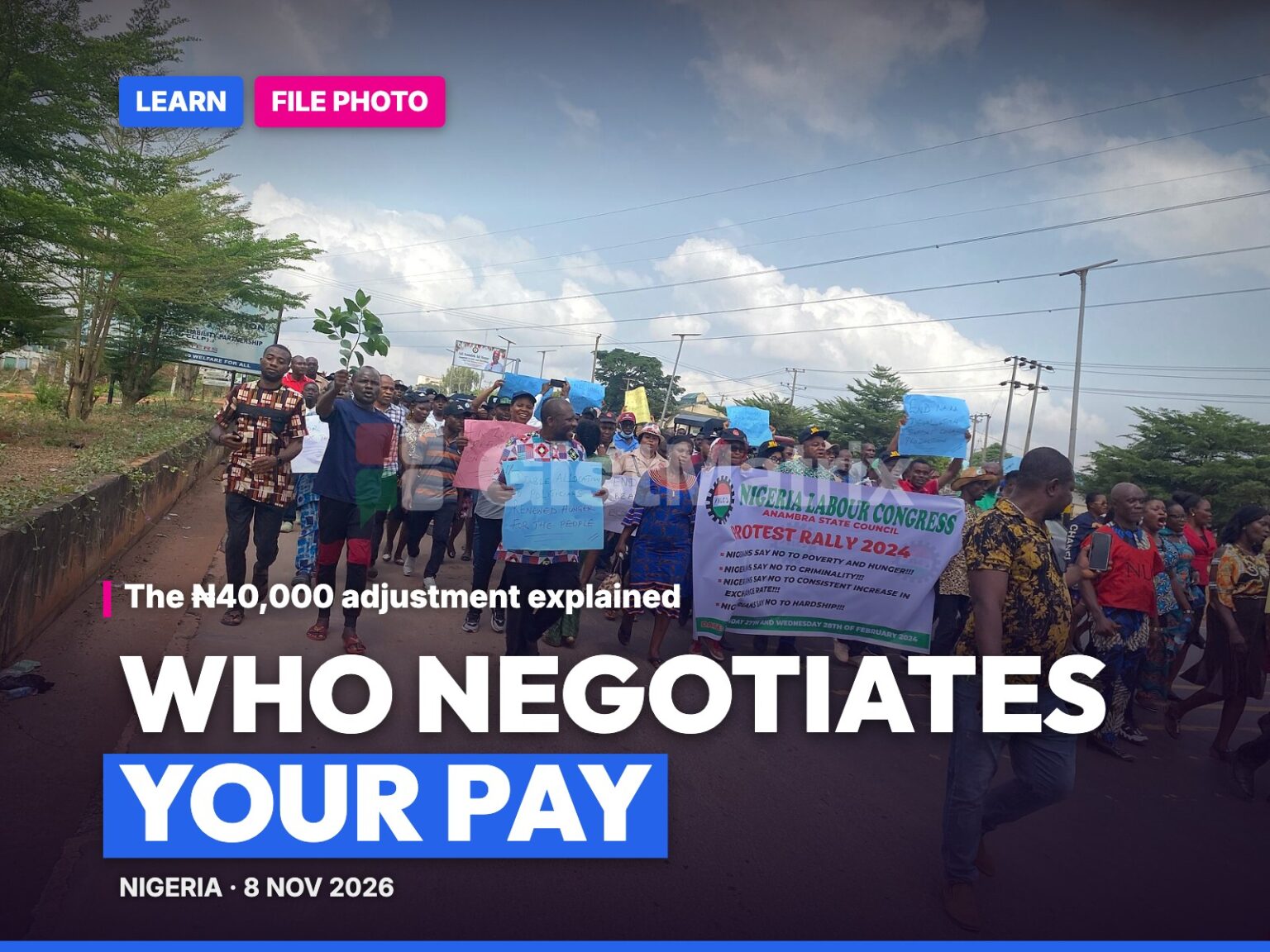
- The NLC said in a statement reported on Sunday, 8 November 2026, that it did not negotiate the ₦40,000 consequential adjustment for federal workers.
- The NLC says it negotiates the national minimum wage, while sector councils and industrial unions negotiate consequential adjustments.
- The government and the NLC agreed on 27 October 2026 to set up a Minimum Wage Negotiation Committee for a new national minimum wage.
The gist in 30 seconds
- The NLC said in a statement reported on Sunday, 8 November 2026, that it did not negotiate the ₦40,000 consequential adjustment for federal workers.
- The NLC says it negotiates the national minimum wage, while sector councils and industrial unions negotiate consequential adjustments.
- The government and the NLC agreed on 27 October 2026 to set up a Minimum Wage Negotiation Committee for a new national minimum wage.
The Nigeria Labour Congress (NLC) says it did not negotiate the ₦40,000 across-the-board consequential adjustment given to federal workers after the ₦70,000 national minimum wage, and that “the N40,000 outcome was the sole responsibility of the leadership of the unions in the public sector”. The statement, signed by the NLC’s Acting General Secretary, Benson Upah, was reported on Sunday, 8 November 2026, by Vanguard and New Telegraph.
Why it matters
Talks on a new national minimum wage are about to begin. On 27 October, the Federal Government and the NLC agreed to set up a Minimum Wage Negotiation Committee, alongside a six-month ₦70,000 transport payment from November. Knowing who negotiates which part of your pay tells you who to hold to account when the next figures are agreed. The NLC said this was “a critical moment” for workers to hold “specific institutions accountable for their specific expectations”.
What did the NLC say?
The Congress said its job in the 2024 exercise was limited to the national minimum wage, which it called the floor below which no worker should be paid. That figure is set in a three-way process between labour, government and employers.
Consequential adjustments, which bring existing salary scales into line with a new minimum wage, are negotiated separately in each sector, it said:
- Federal public service: the Joint National Public Service Negotiating Council, made up of government representatives and about eight unions, negotiates with the Federal Government.
- States: the council’s state-level counterparts negotiate with state governments.
- Private sector: industrial unions negotiate with employers’ associations. The NLC gave the example of the Association of Food, Beverage and Tobacco Employers and the National Union of Food, Beverages and Tobacco Employees.
The NLC said the claim that it negotiated the ₦40,000 was “a deliberate distortion of the collective bargaining framework in Nigeria”. It blamed unnamed “opponents of the trade union movement” for spreading it, and did not say who they were. GistMatrix found no public response from the leadership of the public service negotiating council by Sunday evening.
What does the government’s own record show?
A GistMatrix check of the Federal Government’s account of the 2024 exercise matches the structure the NLC describes. A Federal Ministry of Information release of 20 September 2024 says a committee on consequential salary adjustments, chaired by the Head of the Civil Service of the Federation, Didi Esther Walson-Jack, ended with both sides signing a memorandum of understanding. The national chairman of the negotiating council, Benjamin Anthony, spoke for the trade union side. The release does not give the amounts agreed.
What is a consequential adjustment?
When the minimum wage rises, the lowest-paid workers must be lifted to the new floor. A consequential adjustment is how the rest of the salary scale is moved in response, so that workers on higher grades also see a change. Because it is negotiated sector by sector, workers paid by the Federal Government, a state government or a private company can see different rises from the same new minimum wage.
Why is the ₦40,000 disputed?
The NLC’s statement follows a complaint from three public service unions, the Senior Staff Association of Statutory Corporations and Government-Owned Companies, the Senior Staff Association of Universities, Teaching Hospitals, Research Institutes and Associated Institutions, and the Nigerian Union of Allied Health Professionals. In a joint statement on 1 November, they said the negotiating council had agreed “a flat N40,000 addition across the board” instead of applying the 133% rise given to the lowest-paid worker through the whole salary structure, Vanguard reported. They said this “undermined salary differentials” and asked for a review.
The arithmetic shows why higher grades feel it. Moving the minimum wage from ₦30,000 to ₦70,000 was a rise of about 133%. A flat ₦40,000 is the same 133% for a worker who earned ₦30,000, but only a 20% rise for a worker who earned ₦200,000 a month, a GistMatrix calculation.
What does it mean for you?
- The minimum wage itself: the NLC negotiates the national floor with government and employers.
- Your own salary scale: your sector’s negotiating council or industrial union negotiates how the new floor affects it, according to the NLC.
- The transport payment: the ₦70,000 a month agreed on 27 October is a temporary intervention for six months from November 2026, the Ministry of Labour and Employment said. It is not a pay rise.
What happens next
The ₦70,000 minimum wage became law when President Bola Tinubu signed the bill on Monday, 29 July 2024. The new law also cut the time between minimum wage reviews from five years to three. The Minimum Wage Negotiation Committee agreed on 27 October is due to be set up, and the NLC says it will push for an outcome that “approximates a living wage” and for better ways of handling consequential adjustments.
Are you a federal, state or private-sector worker? Tell GistMatrix what your union has told you about the coming wage talks.
Sources
We checked this story against these sources. How we check
- Vanguard: Controversy: We didn't negotiate N40,000 pay adjustment for federal workers—NLC (NLC statement signed by Benson Upah) (8 Nov 2026)
- New Telegraph: We Did Not Negotiate N40,000 Consequential Adjustment For Workers – NLC (8 Nov 2026)
- Federal Ministry of Information and National Orientation: Consequential Salaries Adjustments Committee: FG And Labour Sign MoU (20 Sep 2024)
- Federal Ministry of Labour and Employment, via Channels Television: FG Approves Six-Month ₦70,000 Transport Support For Workers (27 Oct 2026)
- Nairametrics: President Tinubu signs N70,000 new minimum wage into law (29 Jul 2024)
- Vanguard: ₦70,000 transport intervention: 3 unions disown JNPSNC, back TUC (2 Nov 2026)
How does this story make you feel?

John Christian Mmaduabuchi is a Nigerian filmmaker, creative director, and media professional with extensive experience in digital storytelling, visual journalism, and contemporary media. His Journalism interests span Nigerian and African current affairs, entertainment, culture, technology, lifestyle, media, and the people shaping public conversation. With a background in film direction and documentary production, he brings a strong visual and narrative perspective to editorial work, with particular attention to context, clarity, and compelling storytelling. John is also a creative entrepreneur focused on storytelling, entertainment, culture, and digital content. His professional experience across directing, cinematography, editing, media strategy, and emerging AI technologies gives him a broad understanding of how stories are created, distributed, and consumed in the digital age. At GistMatrix, John contributes to the development and presentation of timely, engaging, and relevant stories for a contemporary audience. His approach to editorial work is grounded in accuracy, context, responsible storytelling, and a commitment to covering stories that matter.
Join the conversation
Be sharp, be kind. Comments are checked before they appear. We remove insults, hate, spam and personal details. Community rules