Power cuts worsen as NISO blames gas shortage and low water: what your band means
NISO says thermal plants are short of gas and hydro dams are low on water, cutting supply hours. What is happening, and what NERC's band rules say you are owed.
By John Christian Mmaduabuchi, Chief Editor
· 5 min read · Abuja
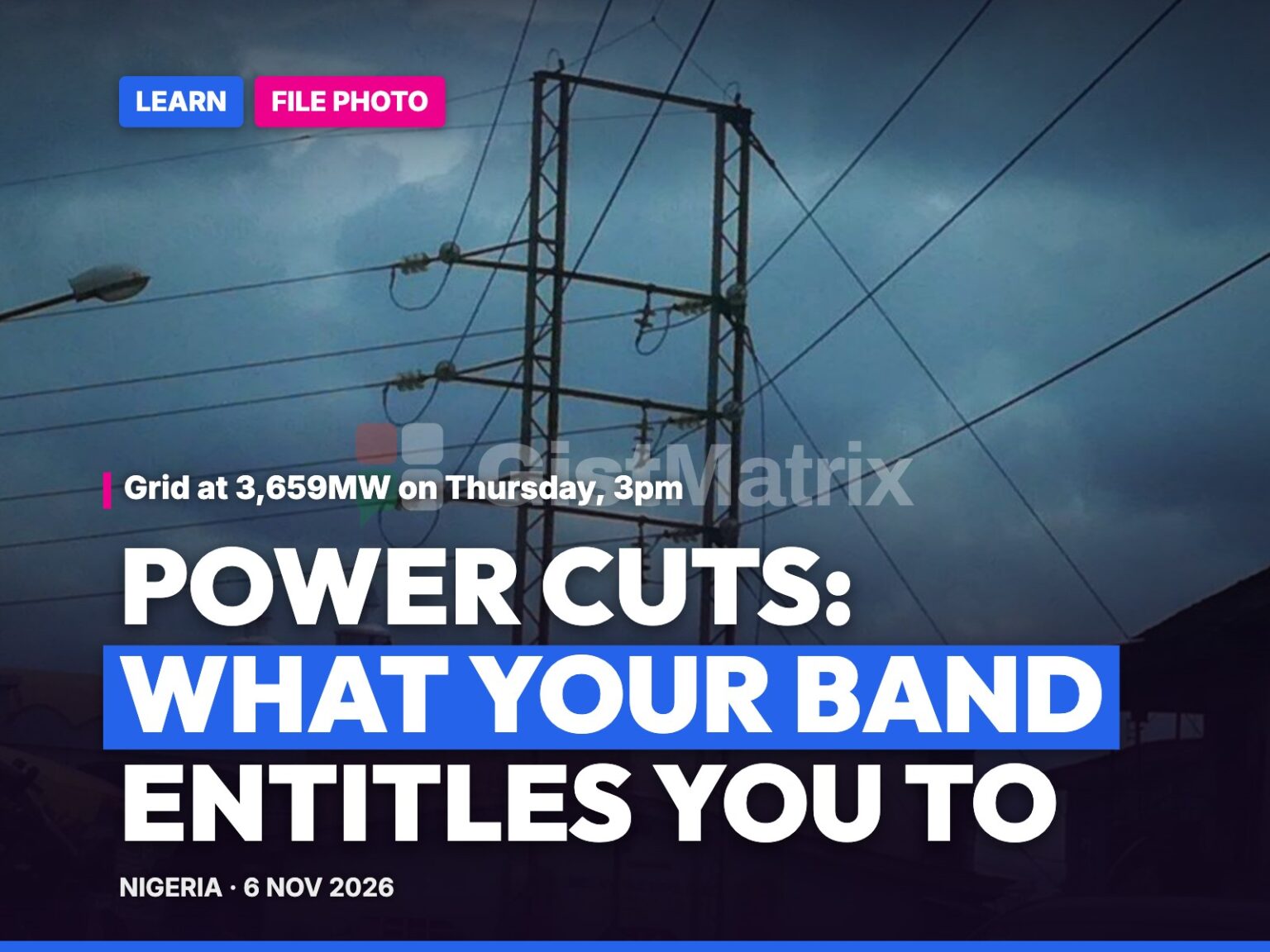
- The Nigerian Independent System Operator (NISO) said on Thursday, 5 November 2026, that limited gas supply to thermal power stations and low water inflows at hydro dams have cut generation on the national grid.
- Generation fell to 3,659MW at 3pm on Thursday from a peak of 3,996MW on Wednesday, and the 11 DisCos shared 3,031MW that evening, according to NISO data reported by Vanguard.
- Under NERC rules, a Band A feeder that misses its 20-hour minimum for seven days in a row must be downgraded to the band that matches the supply it actually received.
The gist in 30 seconds
- The Nigerian Independent System Operator (NISO) said on Thursday, 5 November 2026, that limited gas supply to thermal power stations and low water inflows at hydro dams have cut generation on the national grid.
- Generation fell to 3,659MW at 3pm on Thursday from a peak of 3,996MW on Wednesday, and the 11 DisCos shared 3,031MW that evening, according to NISO data reported by Vanguard.
- Under NERC rules, a Band A feeder that misses its 20-hour minimum for seven days in a row must be downgraded to the band that matches the supply it actually received.
Electricity supply has dropped across Nigeria because thermal power stations are not getting enough gas and hydroelectric dams have less water, the Nigerian Independent System Operator (NISO), which runs the national grid, said on Thursday, 5 November 2026.
The fall in generation has cut the electricity shared out to the 11 distribution companies (DisCos), NISO said, which means fewer hours of supply and more load shedding for homes and businesses. How badly each area is hit depends on how much power its DisCo is allocated.
Why it matters
Fewer hours of grid power push households and small businesses back on to generators, petrol and diesel. It also matters for your bill: under the rules of the Nigerian Electricity Regulatory Commission (NERC), the tariff you pay is tied to the hours of supply your feeder is meant to get.
What NISO said
“The limited availability of gas has constrained the capacity of affected thermal generating stations to operate at their available levels, while reduced water inflows into reservoirs have impacted the generation capacity of hydroelectric power stations,” NISO said in its statement.
It said it recognised the concerns of consumers and was working to diversify the grid’s energy mix, while “optimizing the dispatch of available generation” within current constraints. The statement did not say how much gas the power stations are receiving or when supply is expected to improve.
How low is generation?
Generation on the grid fell to 3,659 megawatts (MW) at 3pm on Thursday, from a peak of 3,996MW on Wednesday, according to NISO data reported by Vanguard. NISO’s allocation dashboard showed the 11 DisCos sharing 3,031MW at 5:39pm on Thursday, the newspaper reported.
Abuja Electricity Distribution Company received the largest share, 669MW, followed by Ibadan with 413MW and Port Harcourt with 338MW. Yola received the least, 74MW. A GistMatrix analysis of those figures shows Abuja alone took about 22% of the power shared out, while Lagos’s two DisCos, Eko (256MW) and Ikeja (249MW), together received 505MW, about a sixth of the total.
The Federal Ministry of Power said on Thursday that it had received complaints from consumers in Lagos, Abuja, Ogun, Kwara and Oyo states. It ruled out a major failure of the national grid and linked the disruptions to maintenance and operational problems, as well as lower generation, Vanguard reported. “We recognise what every hour without power means for individuals, families and businesses, and we do not take it lightly,” the ministry said. It said the Minister of Power, Joseph Tegbe, was working with the Transmission Company of Nigeria, NISO and the DisCos to restore normal supply.
Why does gas matter so much?
Thermal plants, which run on gas, account for the dominant share of Nigeria’s generation mix, NISO has said, so any shortfall in gas quickly shows up as fewer hours of light at home. In February, NISO said thermal plants needed about 1,629.75 million standard cubic feet of gas a day but were receiving about 692 million, less than 43% of what they needed, and average generation had fallen to about 4,300MW. Thursday’s figure of 3,659MW is lower still.
Hydro stations depend on water flowing into their reservoirs. NISO said lower inflows have now reduced their output too.
What does my band entitle me to?
NERC groups customers into bands by the hours of supply their feeder should deliver each day: at least 20 hours for Band A, 16 for Band B and 12 for Band C. Band A customers pay the highest tariff.
Under NERC’s 2024 order on service commitments, if a DisCo fails to meet the promised hours on a Band A feeder for two days in a row, it must publish an explanation on its website by 10am the next day and tell customers when normal service will return. If the failure lasts seven days in a row, the feeder must be moved down to the band that matches the supply it actually received, which means a lower tariff.
Band A feeders that averaged between 18 and 20 hours are covered by NERC’s compensation framework. During the gas shortage in February and March 2026, NERC went further: in June it ordered special compensation for Band A feeders that averaged under 18 hours, worth 20% of the February energy cap for most households (non-maximum-demand customers), paid as token credits or bill adjustments, and said those feeders would not be downgraded. That directive covered only February and March.
What can you do?
- Check your band on your bill, your token receipt or your DisCo’s website.
- Keep a simple log of the hours of supply you get each day.
- If your feeder is falling short of its band, complain to your DisCo first, and take it to NERC’s customer complaints forum if it is not resolved.
What happens next
NISO and the Ministry of Power have not given a date for supply to return to normal. The ministry said the minister had asked operators to speed up maintenance and keep the public informed. GistMatrix will follow NISO’s generation figures and any NERC directive on Band A customers.
How many hours of power are you getting this week? Tell GistMatrix which DisCo supplies you and what you are seeing.
Sources
We checked this story against these sources. How we check
- Nairametrics: FG blames gas shortages, low water inflows for Nigeria's power blackouts (NISO statement) (5 Nov 2026)
- Daily Trust: NISO blames gas shortage for low electricity supply (5 Nov 2026)
- Vanguard: Power generation drops to 3,659MW as FG explains supply disruptions (NISO data, Ministry of Power statement) (5 Nov 2026)
- Arise News: FG blames nationwide power cuts on severe gas supply shortages (NISO statement) (28 Feb 2026)
- Nairametrics: NERC orders compensation for Band A customers affected by power supply shortfalls (Directive NERC/2026/002) (4 Jun 2026)
- Leadership: NERC orders automatic downgrade after 7 days non-performance (MYTO 2024 supplementary order) (5 Apr 2024)
How does this story make you feel?

John Christian Mmaduabuchi is a Nigerian filmmaker, creative director, and media professional with extensive experience in digital storytelling, visual journalism, and contemporary media. His Journalism interests span Nigerian and African current affairs, entertainment, culture, technology, lifestyle, media, and the people shaping public conversation. With a background in film direction and documentary production, he brings a strong visual and narrative perspective to editorial work, with particular attention to context, clarity, and compelling storytelling. John is also a creative entrepreneur focused on storytelling, entertainment, culture, and digital content. His professional experience across directing, cinematography, editing, media strategy, and emerging AI technologies gives him a broad understanding of how stories are created, distributed, and consumed in the digital age. At GistMatrix, John contributes to the development and presentation of timely, engaging, and relevant stories for a contemporary audience. His approach to editorial work is grounded in accuracy, context, responsible storytelling, and a commitment to covering stories that matter.


Join the conversation
Be sharp, be kind. Comments are checked before they appear. We remove insults, hate, spam and personal details. Community rules