Air traffic controllers warn they may withdraw services over failing equipment
Nigeria's air traffic controllers say failing communication and surveillance equipment could push them to withdraw services unless the government sets out a clear plan to replace it.
By John Christian Mmaduabuchi, Chief Editor
· · 4 min read · Lagos
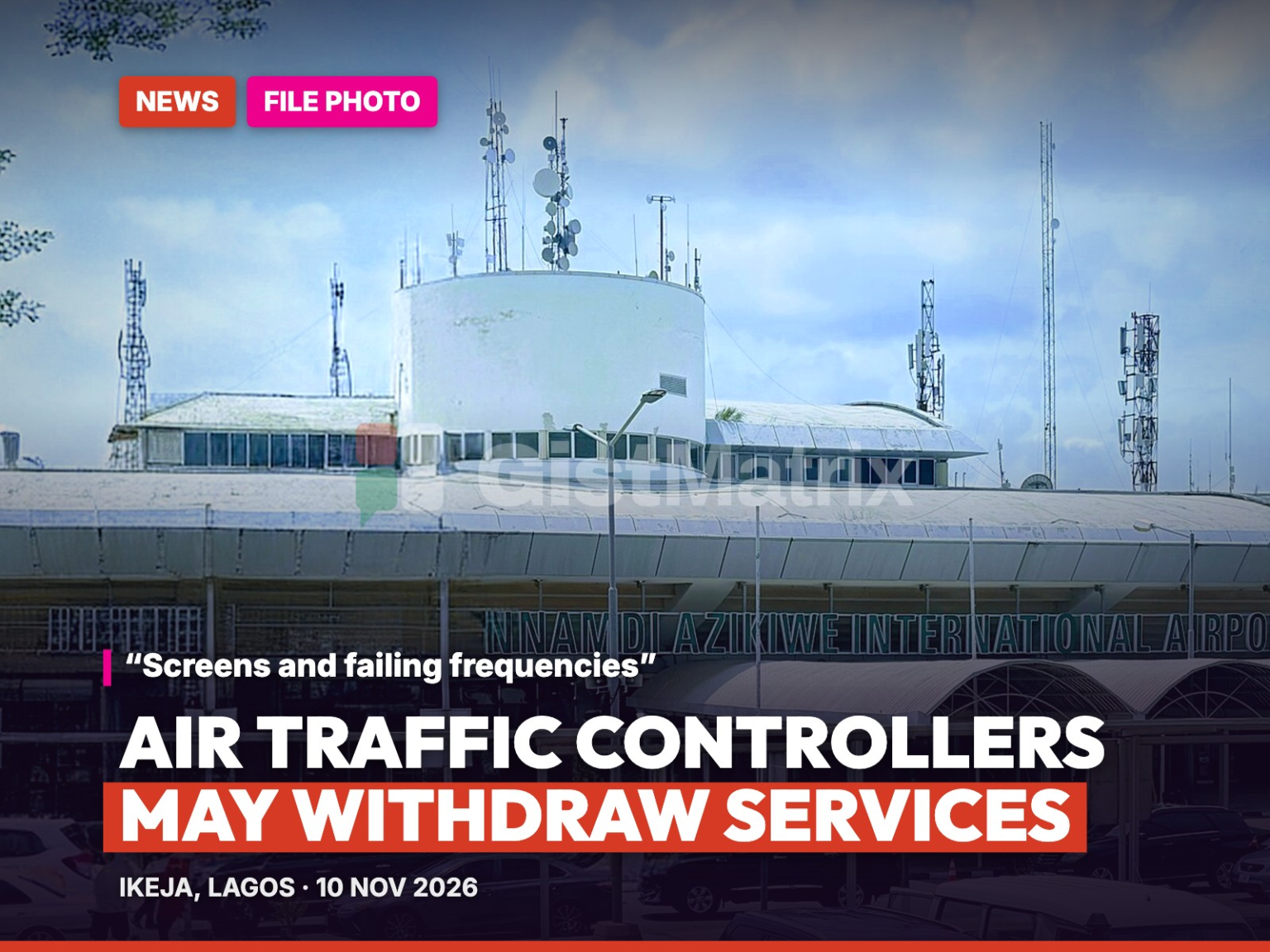
- The Nigerian Air Traffic Controllers' Association (NATCA) said on Tuesday, 10 November 2026, that it is considering withdrawing its services over failing equipment.
- NATCA's president, Edino Ilemona Amos, said announced procurement approvals have not yet improved the equipment controllers use at the console.
- NATCA set no date for any action. NAMA told the same meeting that it had acquired ADS-B equipment and was pursuing a comprehensive overhaul of its radar systems.
Correction, 11 Nov 2026: Correction, 11 Nov 2026: An earlier version of this story said that NAMA had not responded publicly to the controllers' warning and that none of the reports of the meeting carried a response. NAMA's managing director addressed the same meeting through a representative, as BusinessDay reported on Tuesday. The story has been corrected to include what he said. All corrections
The gist in 30 seconds
- The Nigerian Air Traffic Controllers' Association (NATCA) said on Tuesday, 10 November 2026, that it is considering withdrawing its services over failing equipment.
- NATCA's president, Edino Ilemona Amos, said announced procurement approvals have not yet improved the equipment controllers use at the console.
- NATCA set no date for any action. NAMA told the same meeting that it had acquired ADS-B equipment and was pursuing a comprehensive overhaul of its radar systems.
Updated 09:09 WAT, 11 Nov 2026: NAMA told the controllers’ meeting that it had acquired ADS-B equipment and was pursuing an overhaul of its radar systems; this story has been corrected to include the agency’s response.
Nigeria’s air traffic controllers have warned that they may withdraw their services unless the Federal Government sets out a clear plan to overhaul the communication and surveillance equipment they use to guide aircraft through the country’s airspace.
The president of the Nigerian Air Traffic Controllers’ Association (NATCA), Edino Ilemona Amos, gave the warning on Tuesday, 10 November 2026, at the association’s 55th annual general meeting at the Marriott Hotel in Ikeja, Lagos, according to reports of the meeting by Premium Times, BusinessDay and Leadership.
Why it matters
Air traffic controllers keep aircraft safely apart in the air and guide them on and off runways. Every flight in Nigerian airspace relies on them, which is why the warning matters to anyone planning to fly, including travellers booking trips home for Christmas.
NATCA did not give a date or a deadline for any action, and did not say what form it would take, according to the reports.
What the controllers said
Mr Amos said the past year had been a difficult one and that the association’s approaches to the authorities had not produced the equipment controllers need.
“We acknowledge the approvals and procurement milestones that have been announced. However, these have yet to translate into a material improvement in the equipment available to controllers at the console,” he said.
He added: “It is with a deep sense of responsibility that I state that this frustrating engagement is pushing the Association towards considering the withdrawal of our services, should there be no clear strategic plan for the total overhaul of communication and surveillance infrastructure in Nigeria.”
He listed the moments when the gaps are felt most at the console: when a radio frequency fails, when harmattan haze disrupts operations at Kano and Abuja, and when surveillance is lost along the Lagos–Abuja corridor. He said he was speaking “not as a threat, but as patriots who sit daily before screens and failing frequencies to keep this country safe”.
The association said it had raised the problems with the Ministry of Aviation and Aerospace Development, the Nigerian Airspace Management Agency (NAMA), the Office of the National Security Adviser and the National Counter Terrorism Centre, and had sent a memorandum to the National Assembly asking for predictable, ring-fenced funding for aviation infrastructure.
What has the government said?
NAMA set out its position at the same meeting. In an address read on his behalf by the agency’s Director of Air Traffic Services, NAMA’s Managing Director, Farouk Ahmed Umar, said the agency had recently acquired Automatic Dependent Surveillance–Broadcast (ADS-B) equipment, that the first batch of controllers had begun training overseas, and that NAMA was seeking technical support from ASECNA, the Agency for Aerial Navigation Safety in Africa and Madagascar.
“Management is actively pursuing a comprehensive overhaul of our radar systems,” he said. The reports of his remarks gave no timetable or cost for the overhaul.
When the controllers raised similar concerns in April, NAMA said in a statement by its Director of Public Affairs and Consumer Protection, Abdullahi Musa, that claims that Nigerian airspace was unsafe were inaccurate. The agency acknowledged that the Eurocat C radar system in use “is out of date”, said the Federal Government was procuring a modern replacement, and said it had begun deploying Automatic Dependent Surveillance–Broadcast (ADS-B) as a backup to the radar, Daily Trust reported on 13 April.
NATCA said on Tuesday that its training programmes had contributed to Nigeria scoring 91.45% for Effective Implementation during an International Civil Aviation Organization (ICAO) validation mission in April 2026, BusinessDay and Leadership reported.
Who runs Nigeria’s air traffic control?
NAMA provides air navigation services, including air traffic control and the communication, navigation and surveillance equipment controllers depend on. It is separate from the Federal Airports Authority of Nigeria (FAAN), which manages the airports themselves.
This is not the first warning this year. In April, NATCA said it was considering nationwide “flow control”, a technique that limits the number of aircraft entering busy airspace, to ease the workload on tired controllers, Daily Trust reported.
What happens next
The controllers want the government to publish a clear, funded plan to replace the equipment. NAMA says it is pursuing a radar overhaul but has not set out when it will be done or what it will cost. Watch for that plan, and for any formal notice of action from NATCA, which has set no date, before the December travel peak. GistMatrix will update this story as it develops.
Are you a passenger, pilot or airport worker with something to share about flight delays or equipment problems? Send your tips and videos to GistMatrix.
Sources
We checked this story against these sources. How we check
- Premium Times: Nigerian air traffic controllers threaten strike over failing equipment (10 Nov 2026)
- BusinessDay: Air traffic controllers threaten service withdrawal over aging infrastructure (10 Nov 2026)
- Leadership: Flight Disruptions Loom As Air Traffic Controllers Threaten Shutdown Over Ageing Infrastructure (10 Nov 2026)
- Daily Trust: Traffic controllers threaten reduced work, NAMA allays fears (13 Apr 2026)
- BusinessDay: NAMA begins procurement of ADS-B equipment, sets radar overhaul, oversea training in motion (10 Nov 2026)
- Aviation Metric: NATCA demands total overhaul of air navigation tools, NAMA deploys ADS-B, begins radar overhaul (10 Nov 2026)
How does this story make you feel?

John Christian Mmaduabuchi is a Nigerian filmmaker, creative director, and media professional with extensive experience in digital storytelling, visual journalism, and contemporary media. His Journalism interests span Nigerian and African current affairs, entertainment, culture, technology, lifestyle, media, and the people shaping public conversation. With a background in film direction and documentary production, he brings a strong visual and narrative perspective to editorial work, with particular attention to context, clarity, and compelling storytelling. John is also a creative entrepreneur focused on storytelling, entertainment, culture, and digital content. His professional experience across directing, cinematography, editing, media strategy, and emerging AI technologies gives him a broad understanding of how stories are created, distributed, and consumed in the digital age. At GistMatrix, John contributes to the development and presentation of timely, engaging, and relevant stories for a contemporary audience. His approach to editorial work is grounded in accuracy, context, responsible storytelling, and a commitment to covering stories that matter.