NIN drive 59 million short of target as World Bank paper seeks extension to 2027
About 121 million people had a NIN by 30 September, against a target of 180 million, a World Bank paper shows. What the proposed extension, unpaid enrolment partners and school drive mean for you.
By John Christian Mmaduabuchi, Chief Editor
· 4 min read · Abuja
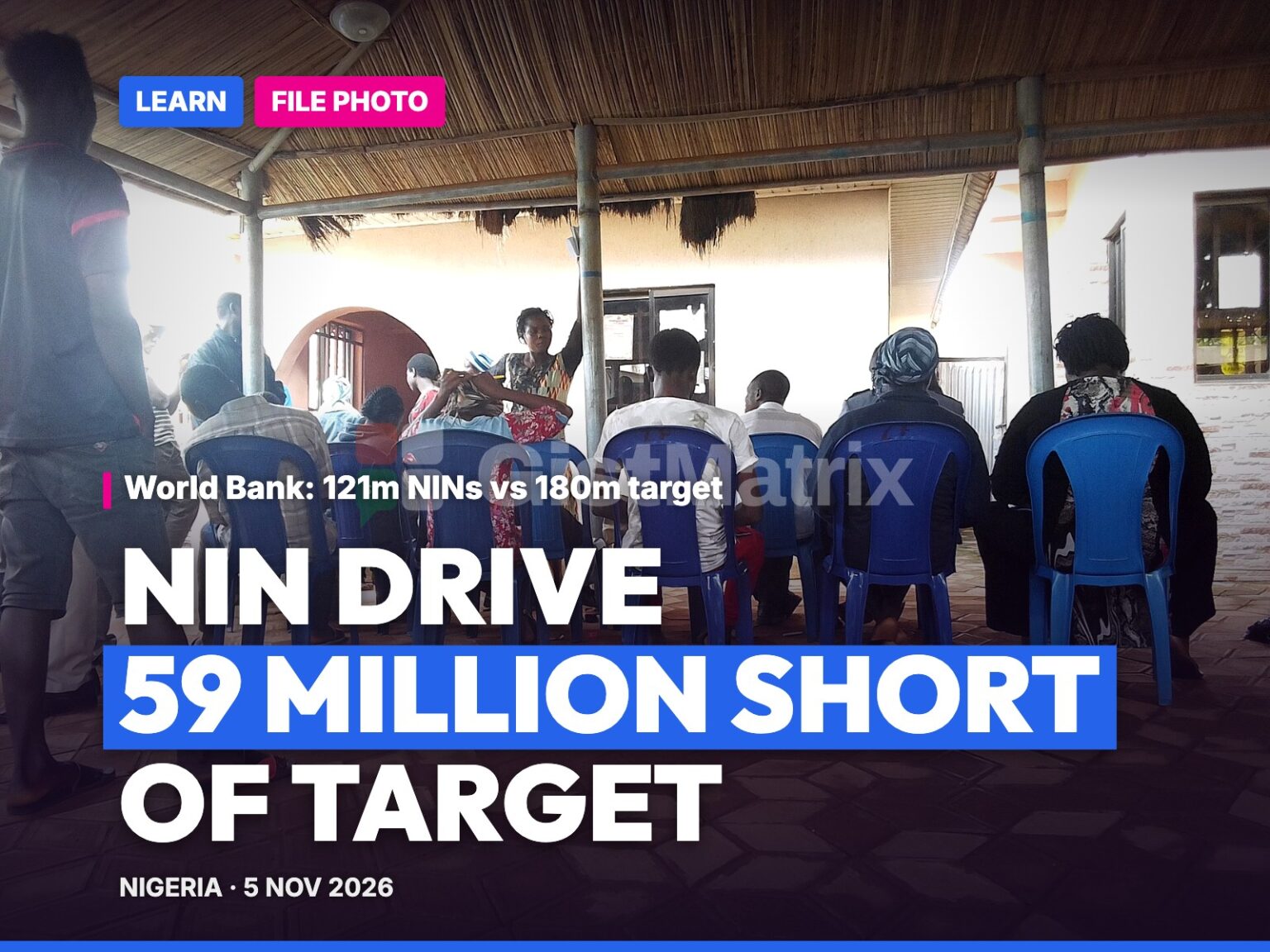
- About 121 million people had a National Identification Number (NIN) on 30 September 2026, against a project target of 180 million, a World Bank restructuring paper dated 22 October 2026 shows.
- The paper proposes extending the $430 million Nigeria ID4D project by 12 months, to December 2027, at the Federal Government's request of 8 May 2026.
- It says NIMC's front-end enrolment partners have not been paid since January 2026, and that school-level enrolment should start by December 2026.
The gist in 30 seconds
- About 121 million people had a National Identification Number (NIN) on 30 September 2026, against a project target of 180 million, a World Bank restructuring paper dated 22 October 2026 shows.
- The paper proposes extending the $430 million Nigeria ID4D project by 12 months, to December 2027, at the Federal Government's request of 8 May 2026.
- It says NIMC's front-end enrolment partners have not been paid since January 2026, and that school-level enrolment should start by December 2026.
About 121 million people had a National Identification Number (NIN) by 30 September 2026, some 59 million short of the 180 million target of Nigeria’s World Bank-backed digital ID project, according to a World Bank restructuring paper dated 22 October 2026. The paper proposes extending the project by 12 months, to December 2027, so that the target can be reached.
A GistMatrix reading of the paper also shows that the private enrolment agents licensed by the National Identity Management Commission (NIMC), known as front-end partners, have not been paid for NINs since January 2026, and that about $196 million of the project’s $430 million had yet to be paid out.
Why it matters
The NIN is fast becoming the key to everyday services. The paper notes that a Central Bank of Nigeria (CBN) policy makes the NIN mandatory for owning a bank account, and that it is also required to receive the government’s cash transfers to poor and vulnerable households. People without one risk being shut out of banking and social support.
The gap is widest for children. As of 30 June 2026, 26.3 million children under 16 had a NIN, 43% of a target of 60.83 million, and 40.4 million women and girls had one, 51% of a target of 79 million, the paper says.
What does the World Bank paper propose?
The Nigeria Digital Identification for Development (ID4D) project was approved in February 2020 and is due to close on 31 December 2026. Its $430 million comes from the World Bank’s International Development Association ($115 million), the French Development Agency, AFD ($100 million equivalent) and the European Investment Bank ($215 million equivalent).
The Federal Government asked for more time on 8 May 2026. The proposed 12-month extension would be the project’s third. The paper says it is needed to reach 180 million NINs, to build NIMC’s new identity system, NIMS 2.0, and to support new laws, including the amended NIMC Act, which received presidential assent on 26 June 2026.
The NIMS 2.0 contract was signed on 15 September 2026 after what the paper calls “significant delays”. The system is due to be in place, with all records moved across, by 15 December 2027.
About $234 million, or 54.4% of the total, has been paid out so far, the paper says. That leaves about $196 million, a GistMatrix calculation shows.
Why are enrolment agents unpaid?
The paper lists seven steps NIMC must complete for the 180 million target to be achievable. One is fixing payments to its partners. “The billing system must generate audited FEP payment reports to enable timely NIN payments to FEPs, which have not been paid since January 2026,” it says.
The paper does not say why the payments stopped. In December 2024, NIMC said it had settled arrears owed to front-end partners for enrolments carried out between 2021 and 2024, Nairametrics reported. GistMatrix will update this story if NIMC comments on the World Bank’s finding.
During a World Bank mission in September 2026, NIMC reconfirmed its commitment to the 180 million target but said monthly enrolment would have to rise from an average of 1.5 million to 3.9 million, the paper says. At 1.5 million a month, the remaining 59 million NINs would take more than three years; at 3.9 million, about 15 months, a GistMatrix calculation shows.
What it means for you
- Enrolment closer to home: a ward-level drive launched in March 2026 has produced 10 million new NINs and should reach every ward by November 2026, the paper says.
- Children at school: NIMC is to work with the Ministry of Education to start enrolling pupils in schools by December 2026.
- More places to enrol: about 365 licensed partners, including mobile networks, can enrol people, and 7,000 mobile enrolment devices bought by the project are due to be deployed by January 2027.
- Social support: NIMC is working with the National Social Safety-Nets Coordinating Office (NASSCO) and the National Health Insurance Authority to enrol poor and vulnerable people. As of 30 June 2026, 13.2 million people on the National Social Register had a NIN.
What happens next
The paper set 31 October 2026 as the deadline for a new online system to train and certify enrolment agents; it is not yet clear whether it was met. Ward-level enrolment is due in every ward by November, school enrolment should start by December, and the new devices are due by January 2027. If the extension goes ahead, the project will close in December 2027, when NIMS 2.0 is also due.
Have you struggled to get a NIN in your area, or are you an enrolment agent waiting to be paid? Tell GistMatrix.
Sources
We checked this story against these sources. How we check
- GistMatrix: a reading of the World Bank restructuring paper on the Nigeria ID4D project (5 Nov 2026)
- World Bank: Disclosable Restructuring Paper, Nigeria Digital Identification for Development Project, P167183 (22 Oct 2026)
- World Bank: Nigeria Digital Identification for Development Project, project documents (22 Oct 2026)
- Nairametrics: World Bank flags unpaid NIN agents as 59 million Nigerians remain unenrolled (5 Nov 2026)
How does this story make you feel?

John Christian Mmaduabuchi is a Nigerian filmmaker, creative director, and media professional with extensive experience in digital storytelling, visual journalism, and contemporary media. His Journalism interests span Nigerian and African current affairs, entertainment, culture, technology, lifestyle, media, and the people shaping public conversation. With a background in film direction and documentary production, he brings a strong visual and narrative perspective to editorial work, with particular attention to context, clarity, and compelling storytelling. John is also a creative entrepreneur focused on storytelling, entertainment, culture, and digital content. His professional experience across directing, cinematography, editing, media strategy, and emerging AI technologies gives him a broad understanding of how stories are created, distributed, and consumed in the digital age. At GistMatrix, John contributes to the development and presentation of timely, engaging, and relevant stories for a contemporary audience. His approach to editorial work is grounded in accuracy, context, responsible storytelling, and a commitment to covering stories that matter.




Join the conversation
Be sharp, be kind. Comments are checked before they appear. We remove insults, hate, spam and personal details. Community rules